


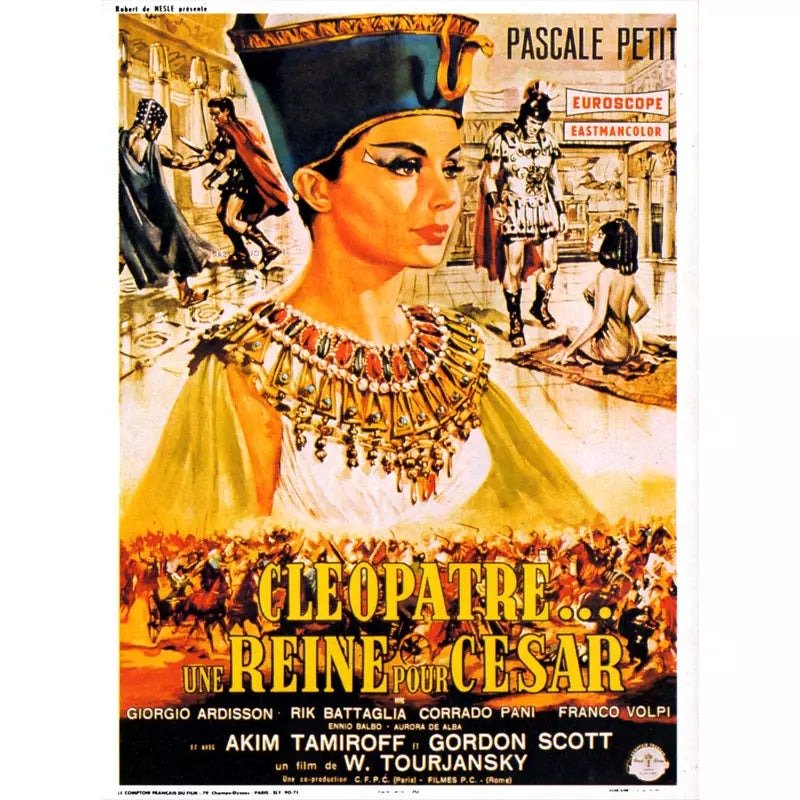
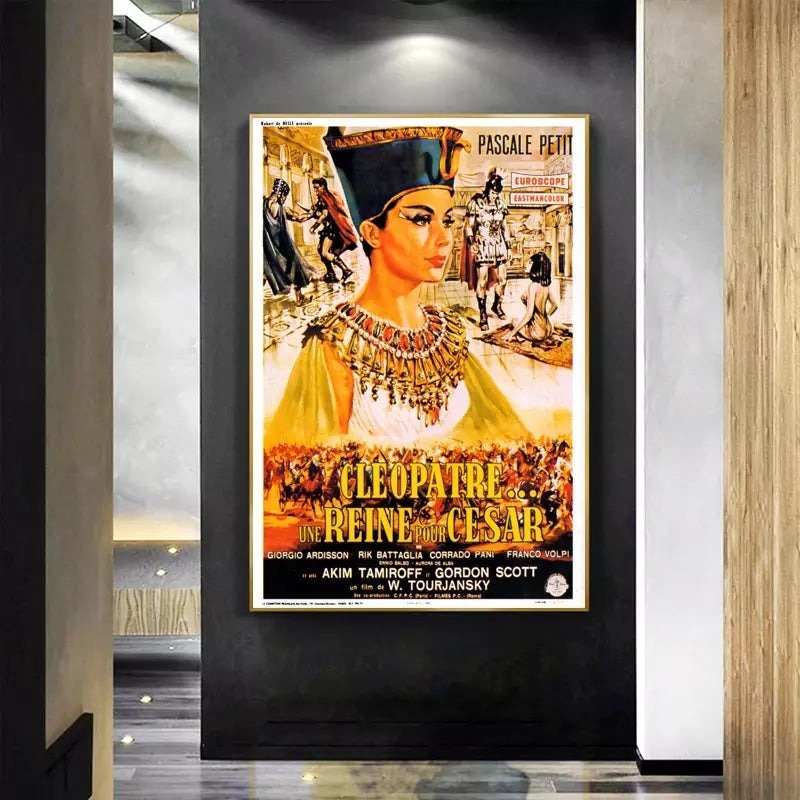
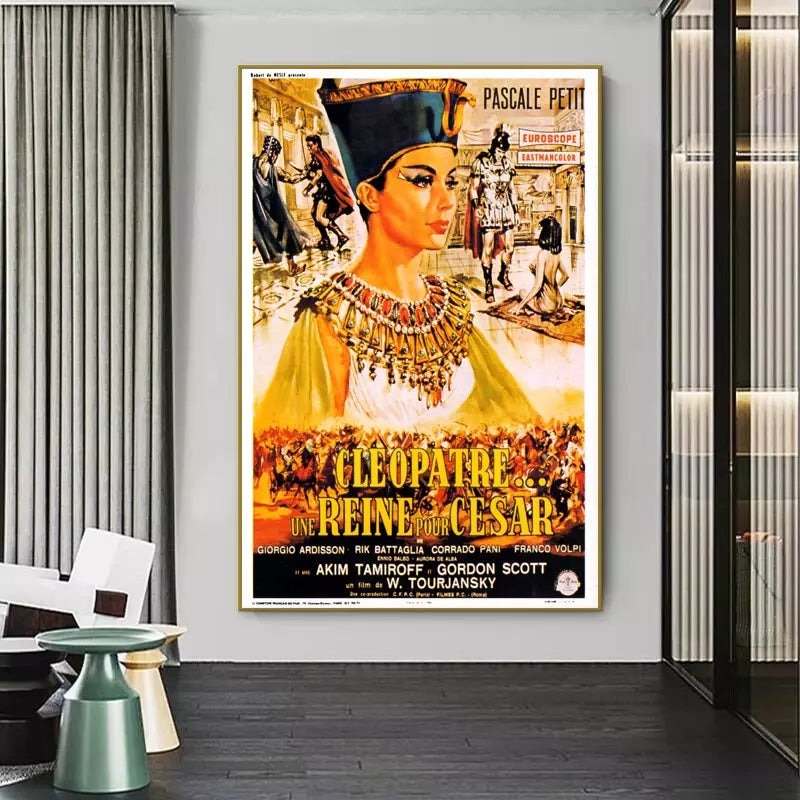
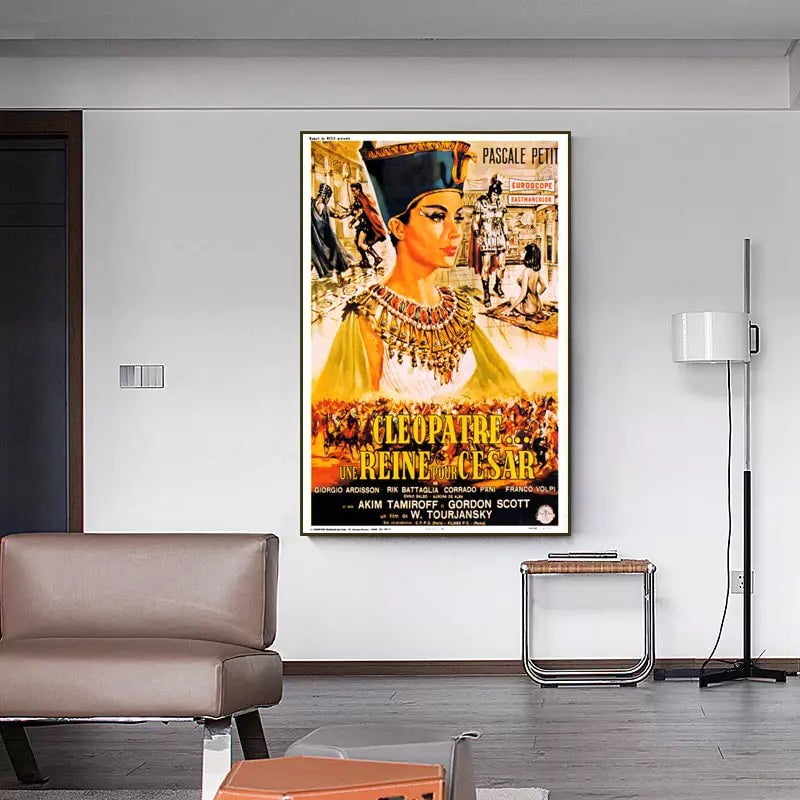
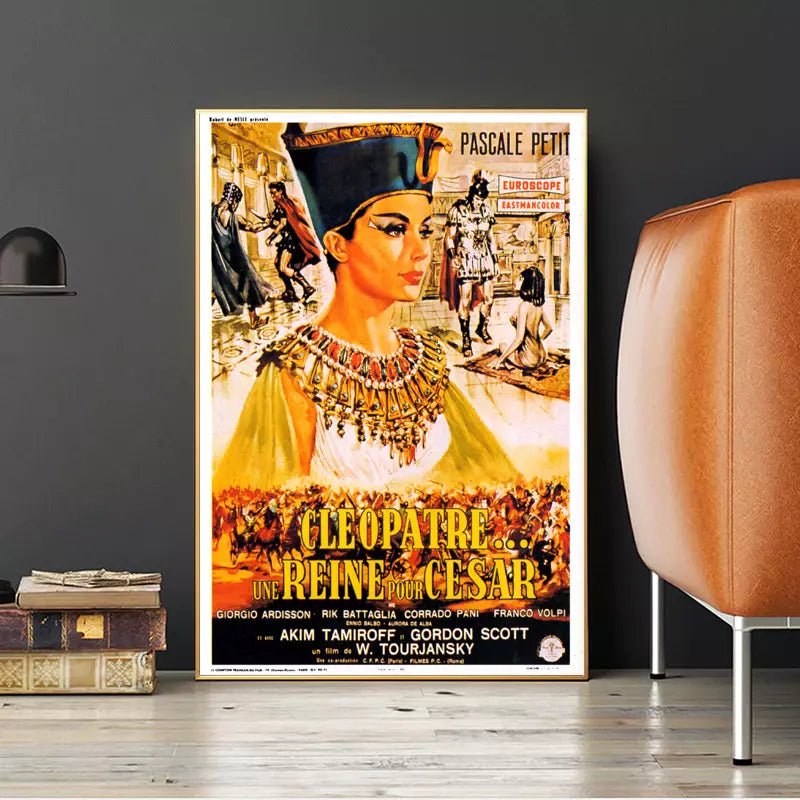
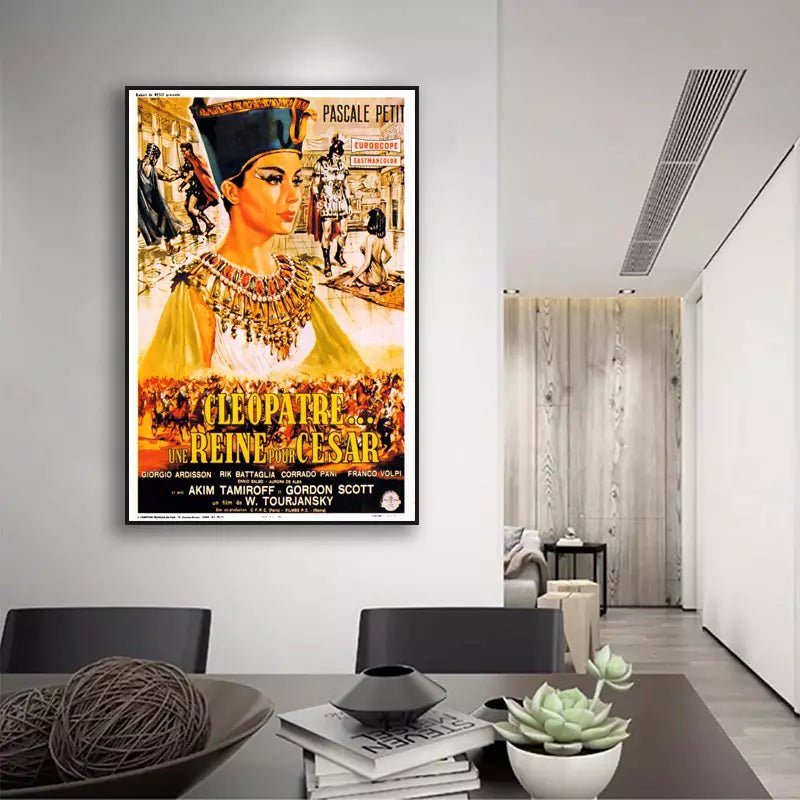
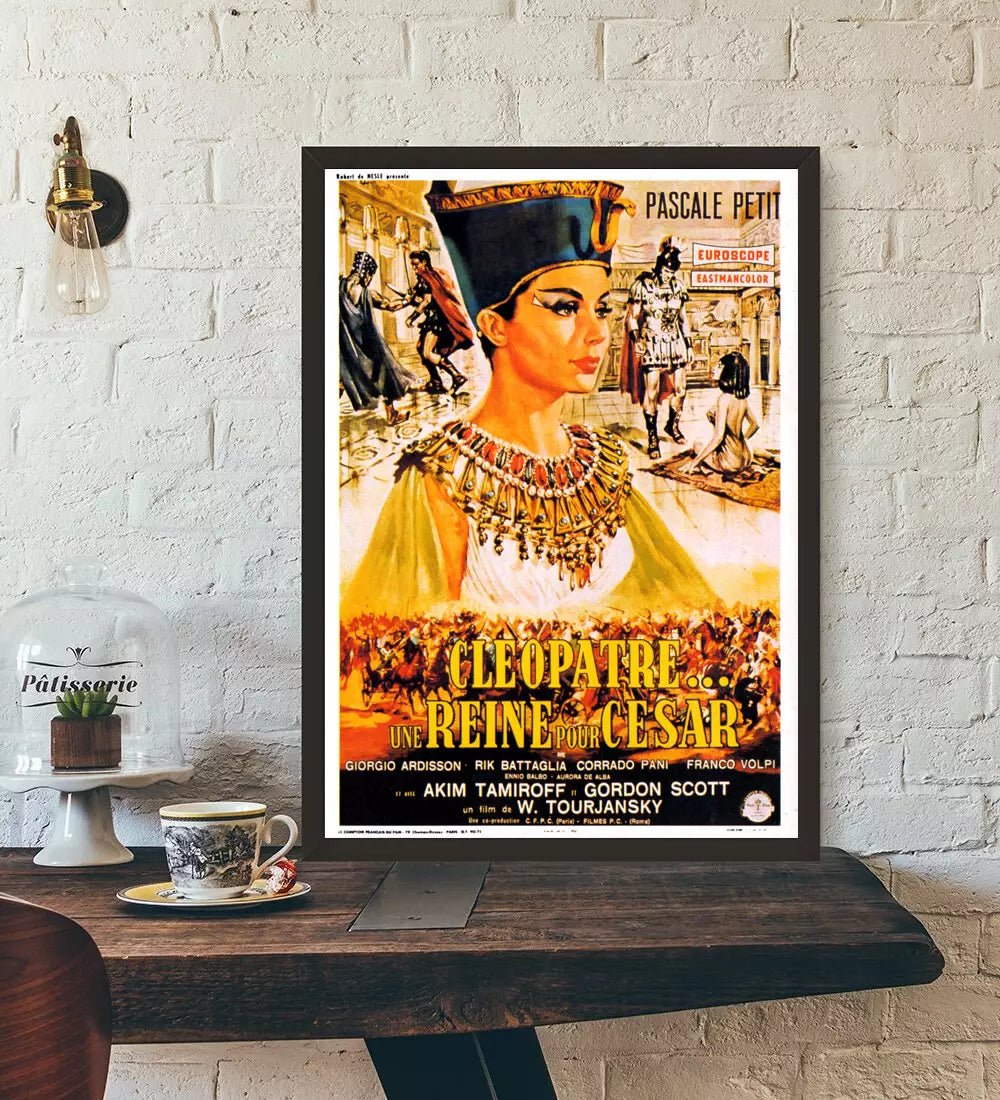
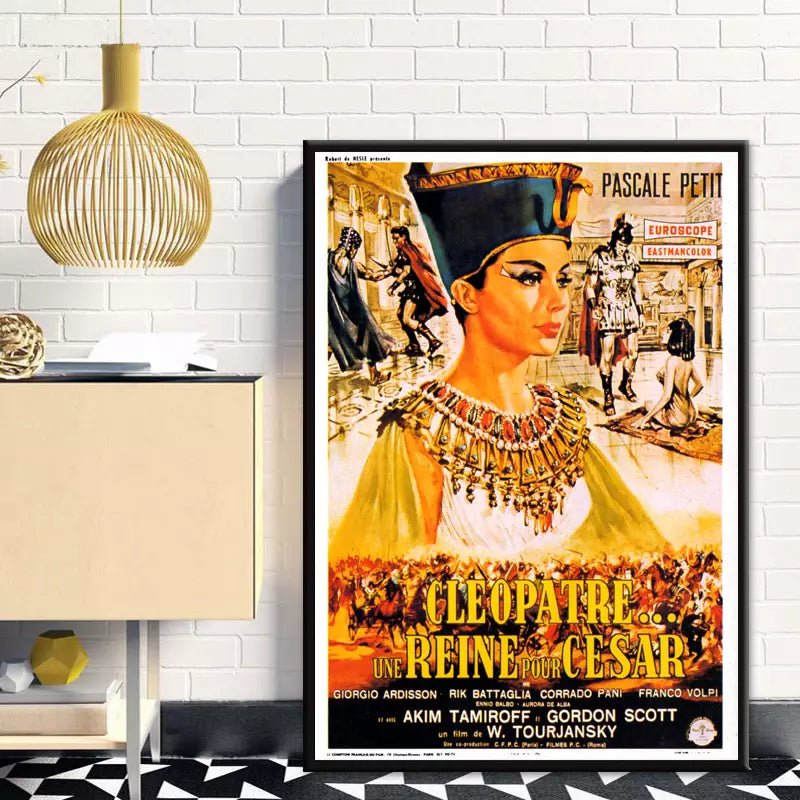
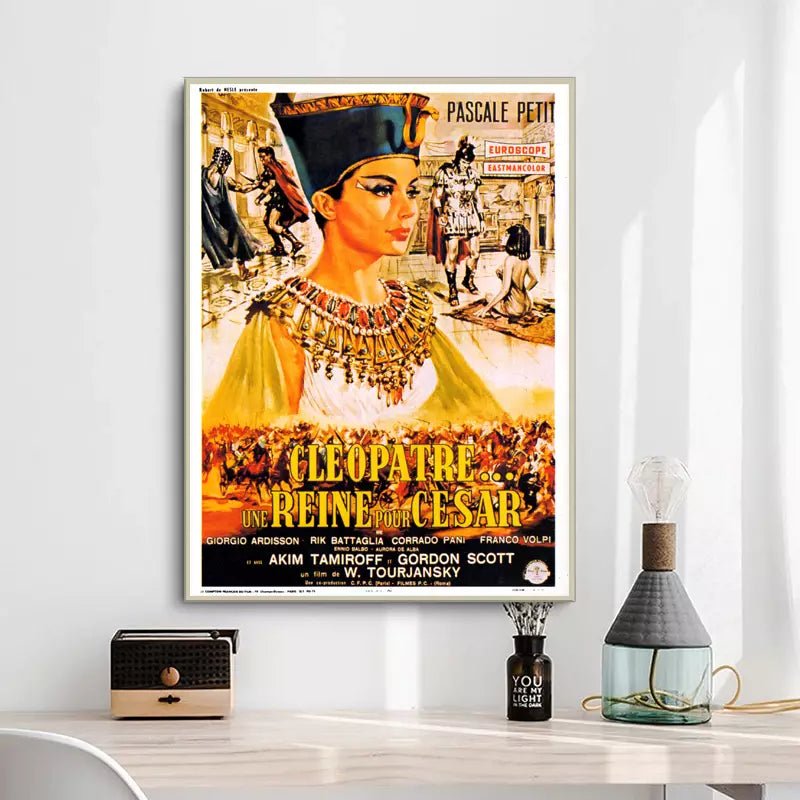
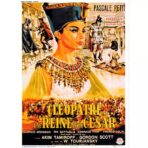



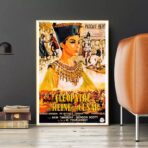

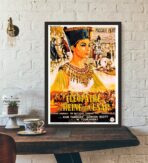

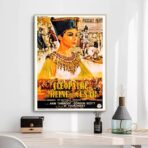













Discover the breathtaking Cleopatra Poster, the 1963 cinematic masterpiece. Be transported to the opulence and political intrigue of ancient Egypt, where searing emotions, betrayals, and tumultuous love affairs come to life under the visionary direction of Joseph L. Mankiewicz. Witness Elizabeth Taylor gracefully and powerfully portray the legendary Queen Cleopatra, while Richard Burton embodies the magnetic Mark Antony. This epic fresco, combining sumptuous sets and unforgettable performances, will deliver an unforgettable cinematic experience, imbued with passion, drama, and grandeur.
- Paper Feature:
- 🎨 Canvas: The global standard in printing and imitating a “canvas” look.
- By default, the poster contains a 4cm white border for framing (frame not included). If you don’t want it, please choose “without white border”.
- ✅ Size: several choices available. ✅
- High UV resistance.
- Maximum color brilliance , without reflections.
- Recycled paper guaranteed a environmentally friendly.
- Poster packaged carefully and delivered in a protective tube for total protection.
- FREE STANDARD DELIVERY.
⚠️ Frame not included. ⚠️
Description of this Cleopatra Poster
Cleopatra is a 1963 American epic historical drama film directed by Joseph L. Mankiewicz, with a screenplay adapted by Mankiewicz, Ranald MacDougall, and Sidney Buchman from the 1957 book The Life and Times of Cleopatra by Carlo Maria Franzero, and stories by Plutarch, Suetonius, and Appian. The film stars Elizabeth Taylor in the eponymous role. Richard Burton, Rex Harrison, Roddy McDowall, and Martin Landau are featured in supporting roles. It chronicles the struggles of Cleopatra, the young queen of Egypt, to resist Rome’s imperial ambitions.
Walter Wanger had long considered producing a biopic about Cleopatra. In 1958, his production company partnered with Twentieth Century Fox to produce the film. After an extensive casting search, Elizabeth Taylor signed on to play the title role for a record-breaking salary of $1 million. Rouben Mamoulian was hired as director, and the script underwent numerous revisions by Nigel Balchin, Dale Wasserman, Lawrence Durrell, and Nunnally Johnson. Principal photography began at Pinewood Studios on September 28, 1960, but Taylor’s health problems delayed filming. Production was suspended in November after going over budget with only ten minutes of usable footage.
Mamoulian resigned as director and was subsequently replaced by Joseph L. Mankiewicz, who had previously directed Taylor in Suddenly, Last Summer (1959). Production was relocated to Cinecittà, where filming resumed on September 25, 1961, without a completed shooting script. During filming, a personal scandal made global headlines when it was reported that co-stars Taylor and Richard Burton were having an adulterous affair. Filming was completed on July 28, 1962, and further reshoots were conducted from February to March 1963. With production costs estimated at $31 million, the film became the most expensive film ever made to that point and nearly bankrupted the studio.
Cleopatra premiered at the Rivoli Theatre in New York City on June 12, 1963. It received a generally favorable response from film critics and became the highest-grossing film of 1963, earning $57.7 million in box office receipts in the United States and Canada, and one of the highest-grossing films of the decade worldwide. However, the film initially lost money due to its $44 million production and marketing costs. It received nine nominations at the 36th Academy Awards, including Best Picture, and won four: Best Art Direction (Color), Best Cinematography (Color), Best Visual Effects, and Best Costume Design (Color).
After the Battle of Pharsalus in 48 BC, Julius Caesar travels to Egypt, under the pretense of being appointed executor of the will of the young Pharaoh Ptolemy XIII’s father and his sister Cleopatra. Ptolemy and Cleopatra are in the midst of a civil war of their own, and she has been driven from the city of Alexandria. Ptolemy rules alone under the watchful eye of his three “guardians,” the chief eunuch Pothinus, his tutor Theodotus, and the general Achillas.
Cleopatra convinces Caesar to restore her younger brother to his throne. Caesar, in effective control of the kingdom, condemns Pothinus to death for organizing an assassination attempt on Cleopatra and banishes Ptolemy to the eastern desert, where he and his outnumbered army faced certain death at the hands of Mithridates. Cleopatra is crowned Queen of Egypt and begins to dream of ruling the world with Caesar, who in turn desires to become King of Rome. They marry, and when their son Caesarion is born, Caesar publicly accepts him, which becomes the talk of Rome and the Senate.
After being named dictator for life, Caesar sends for Cleopatra. She arrives in Rome in a lavish procession and wins the adulation of the Roman people. The Senate grows increasingly disgruntled amid rumors that Caesar wishes to become king. On the Ides of March in 44 BC, a group of conspirators assassinates Caesar and flees the city, sparking a rebellion. An alliance between Octavian (Caesar’s adopted son), Mark Antony (Caesar’s right-hand man and general), and Marcus Ameilius Lepidus suppresses the rebellion and divides the republic. Cleopatra is angered after Caesar’s will recognizes Octavian, rather than Caesarion, as his official heir and returns to Egypt. While planning a campaign against Parthia in the east, Antony realizes he needs money and supplies, which only Egypt can sufficiently provide. After repeatedly refusing to leave Egypt, Cleopatra acquiesces and meets him on his royal barge in Tarsus. The two begin a romance. Octavian’s withdrawal from Lepidus forces Antony to return to Rome, where he marries Octavian’s sister Octavia to prevent political conflict. This enrages Cleopatra. Antony and Cleopatra reconcile and marry, with Antony divorcing Octavia. An exasperated Octavian reads Antony’s will to the Roman Senate, revealing that Antony wishes to be buried in Egypt. Rome turns against Antony, and Octavian’s call for war against Egypt receives a rapturous response. The war is decided at the naval Battle of Actium on September 2, 31 BC, where Octavian’s fleet, under the command of Agrippa, defeats the lead ships of the Antony-Egyptian fleet. Assuming Antony is dead, Cleopatra orders the Egyptian forces home. Antony follows her, leaving his fleet leaderless and soon defeated. Several months later, Cleopatra dispatches Caesarion in disguise from Alexandria. She also convinces Antony to resume command of his troops and fight Octavian’s advancing army. However, Antony’s soldiers abandon him during the night. Rufio, the last man loyal to Antony, kills himself. Antony tries to goad Octavian into single combat, but is ultimately forced to flee into the city. When Antony returns to the palace, Apollodorus, himself in love with Cleopatra, tells him that she is in her tomb as she had requested, and lets Antony believe she is dead. Antony falls on his own sword. Apollodorus then confesses that he misled Antony and assists him at the tomb where Cleopatra and two servants have taken refuge. Antony dies in Cleopatra’s arms.
Octavian and his army enter Alexandria with Caesarion’s corpse in a wagon. He discovers the corpse of Apollodorus, who had poisoned himself. Octavian learns that Antony is dead and Cleopatra is buried in a tomb. There, he offers her the rule of Egypt as a Roman province if she accompanies him to Rome. Cleopatra, knowing that her son is dead, agrees to Octavian’s conditions, including a pledge on her son’s life not to harm himself. After Octavian leaves, she surreptitiously orders her servants to help her commit suicide. Discovering that she is going to kill herself, Octavian and his guards burst into Cleopatra’s room to find her dead, dressed in gold, along with her servants and the asps who killed her.