


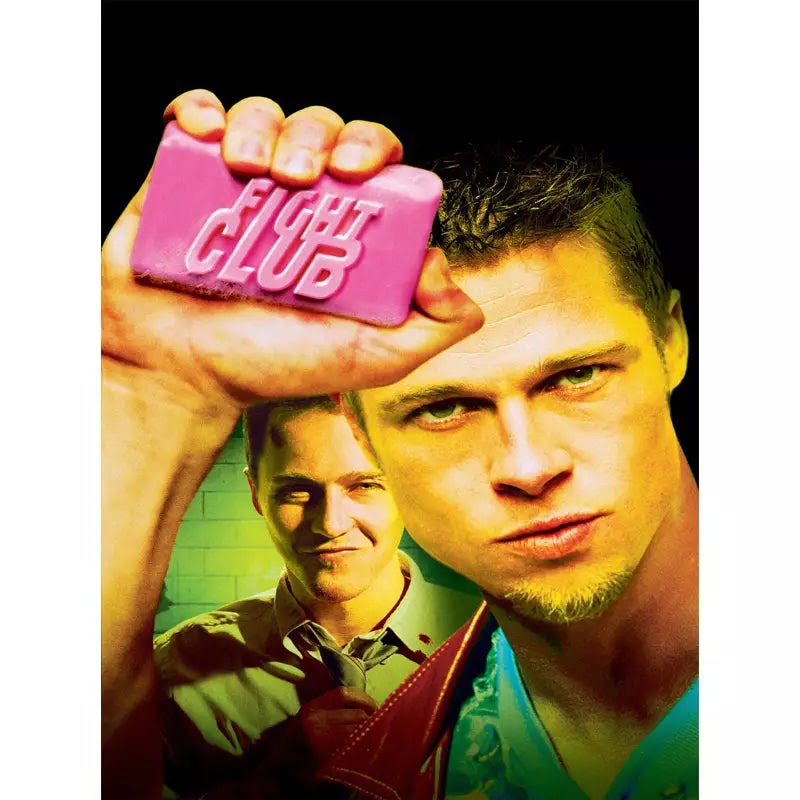






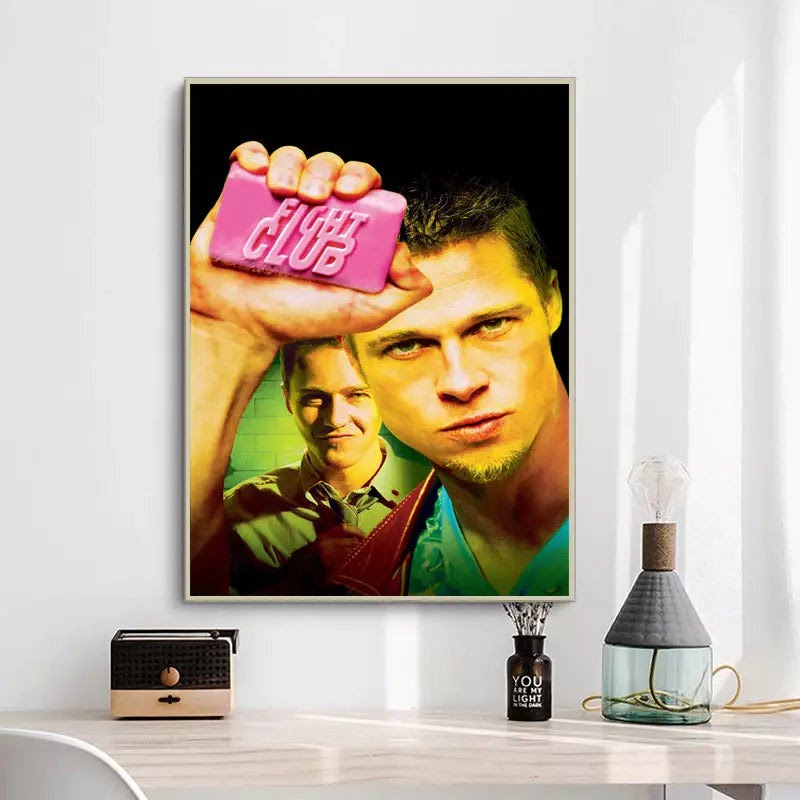














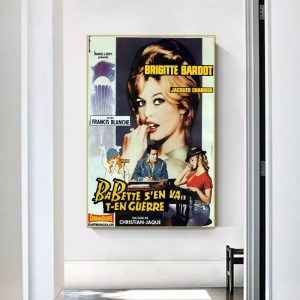









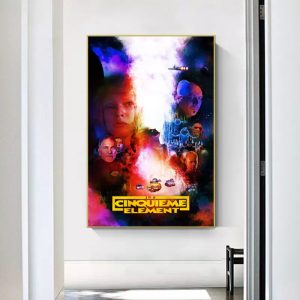

Discover the must-have Fight Club Poster and dive into an ocean of intense emotions. Explore the psychological depths and duality of the characters that make this film a true cinematic masterpiece. Our captivating poster captures the rebellious essence, the quest for identity, and the existential questions that emanate from this cult work. Add an iconic piece to your collection and feel the full intensity of “Fight Club” through this stunning visual representation.
- Paper Feature:
- 🎨 Canvas: global standard in terms of print and imitating a “painting canvas” look.
- By default, the poster contains a 4cm white border for framing (frame not included). If you don’t want it, please choose “without white border”.
- ✅ Size: Multiple choices available. ✅
- High UV resistance.
- Maximum color brilliance without reflections.
- Recycled paper guaranteed environmental friendliness.
- Poster wrapped carefully and delivered in a protective tube for total protection.
- FREE STANDARD DELIVERY.
⚠️ Frame not included. ⚠️
Description of this Fight Club Poster
Fight Club (known as El club de la lucha in Spanish and El club de la pelea in Latin America) is a 1999 German-American film based on the novel of the same name by Chuck Palahniuk. The film was directed by David Fincher and stars Edward Norton, Brad Pitt, and Helena Bonham Carter. Norton plays the protagonist, an unnamed “everyman” bored with his profession in American society, who forms an underground “fight club” with a soap salesman named Tyler Durden (played by Brad Pitt) and begins a relationship with Marla Singer, played by Helena Bonham Carter.
Chuck Palahniuk’s novel was picked up by Laura Ziskin, a producer at 20th Century Fox, who hired Jim Uhls to write the screenplay for the film adaptation. David Fincher was one of four directors considered and was ultimately hired due to his enthusiasm for the project. Fincher developed the screenplay with Uhls and solicited writing assistance from actors and other members of the film industry. The director and cast have compared the film to Rebel Without a Cause (1955) and The Graduate (1967). Fincher intended the film’s violence to serve as a metaphor for the conflict between the younger generation and the advertising value system.45 The director copied the homoerotic overtones of Palahniuk’s novel to make audiences uncomfortable and prevent them from anticipating the dramatic twist at the end.
Studio executives disliked the film and restructured the marketing campaign in an attempt to reduce potential losses. Fight Club failed to meet the studio’s box office expectations and received polarized reactions from critics, becoming one of the most controversial and discussed films of the year. Critics praised the acting, direction, themes, and messages, but debated the graphic violence and moral ambiguity. Over time, however, the film’s reception became very positive among critics and audiences, and it achieved critical and commercial success upon its DVD release, leading to Fight Club becoming a cult classic. It is now considered by many to be one of the best films of the 1990s.
The narrator (Edward Norton), who suffers from insomnia and whose name is never mentioned, is an employee of an automobile company. His doctor refuses to prescribe him medication and, when he complains of suffering, tells him that he should go to a support group to see what real suffering is. The narrator attends a support group for testicular cancer victims and, after convincing them that he too has the disease, finds an emotional release that cures his insomnia. He becomes addicted to the therapy groups and the charade of pretending to be a victim. However, the presence of Marla Singer (Helena Bonham Carter) bothers him, as he realizes she’s looking for the same solution to her life’s problems and fears she’ll tell everyone on him, so he negotiates with her to avoid the same meetings.
On the flight back from a business trip, he begins talking with a stranger who introduces himself as a soap salesman named Tyler Durden (Brad Pitt). They strike up a conversation about nihilism and the importance of doing what you think is right. Back in his hometown, he realizes his apartment has been destroyed by an explosion and calls Tyler, whom he meets at a bar. A conversation about consumerism leads Tyler to invite the narrator to stay at his house. Initially reluctant, the narrator eventually accepts the invitation. Tyler agrees to let the narrator stay at his house on the condition that he beat him up. They have a fistfight outside the bar, after which the narrator moves into Tyler’s gaunt house. The punches and brawls, which eventually become commonplace between the two, attract curious onlookers, and the fights move to the bar’s basement, where a fight club forms, governed by a set of rules (not the least of which is not to tell anyone else about the fight club).
Marla overdoses on pills and calls the narrator for help; he ignores her, but Tyler takes the call and decides to pursue her. After they have sex, Tyler warns the narrator never to speak to him about Marla. What seemed like a local affair becomes an advanced underground fight club, gaining followers across the country. Other fight clubs form, becoming an anti-capitalist, anti-corporate organization called Project Mayhem, of which Tyler is the leader. The narrator complains to Tyler because he wants more importance in the organization, after which Tyler disappears. The narrator is confronted with the death of a member (Bob) of Project Mayhem and attempts to shut down the organization. He attempts to find Tyler, but his search is unsuccessful. In one of the cities where he searches for him, a member of the project calls the narrator by the name Tyler Durden. After this, the narrator calls Marla from his hotel room and discovers that she also mistakes him for Tyler. Suddenly, she sees Tyler Durden in the room, and he explains to her that they are split personalities in the same body. Tyler controls the narrator’s body while he is asleep.
After the shock, the narrator loses consciousness. When he wakes up, he discovers, through phone records, that Tyler made calls while unconscious. He unmasks Tyler’s plans to create social chaos by destroying the buildings containing the credit card company records. In this way, the bank debt records of a large portion of the population would be destroyed. The narrator attempts to contact the police, but the agents he addresses are also part of the Project and attempt to “cut off his balls” for revealing the organization’s secrets. The protagonist manages to escape by taking one of their guns. He arrives at one of the buildings to be demolished and attempts to defuse the explosives, but Tyler overpowers him and goes to another building to witness the explosion. The narrator, harassed by Tyler at gunpoint, realizes that by sharing a body, he is also holding the same gun. He therefore accepts his personality (Tyler Durden) and shoots himself in the cheek, signaling to his partner that he no longer needs him in his life. Tyler collapses with a bullet hole in the back of his head, and the narrator stops mentally projecting. Later, members of Project Mayhem bring the kidnapped Marla to him, still believing her to be Tyler, and they are left alone. Explosives are detonated, causing buildings to collapse, while the narrator and Marla watch, holding hands.