
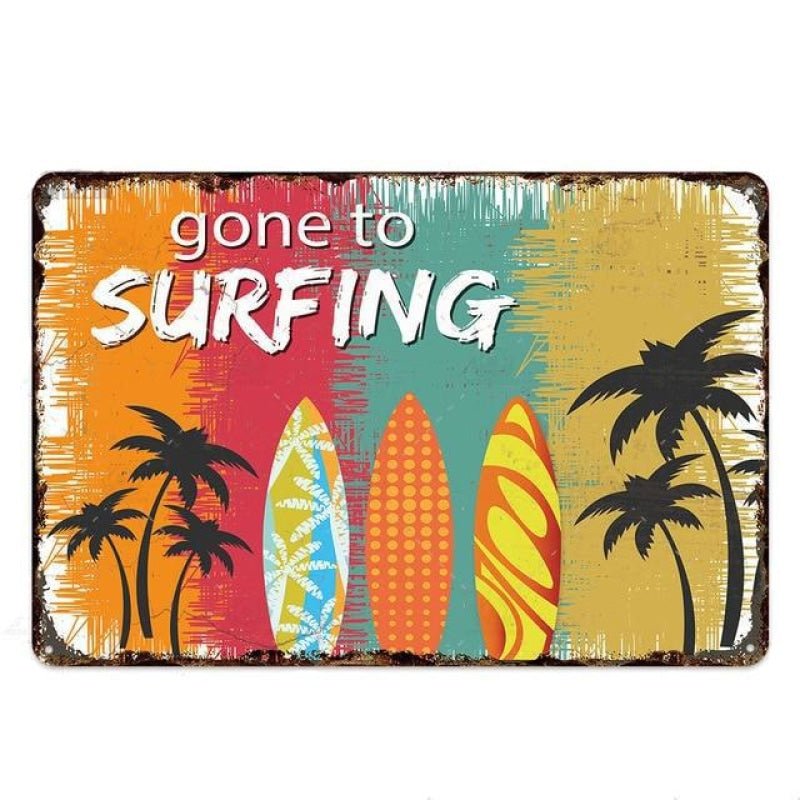







If you love the beach and vacations, then this Vintage Surf Plaque will bring a vacation and tropical atmosphere to your interior decoration!
- ⚡ WITH THE PURCHASE OF TWO VINTAGE METAL PLAQUES, THE 3RD IS FREE! ⚡
- Materials:
- Metal protected against corrosion, built to last.
- Very light and easy to install.
- Packaged carefully and placed in a shock-resistant package for safe transport.
- Size: 20 (W) × 30 (L) cm / 30 (W) × 40 (L) cm.
- FREE SECURE DELIVERY & SHIPPED WITHIN 48/72 HOURS (see our FAQs).
Description of this Vintage Surf Plaque
Surfing is a surface sport in which an individual, the surfer, uses a board to ride the front, or face, of a moving water wave, which usually carries the surfer toward the shore. Waves suitable for surfing are found primarily on ocean shores, but can also be found in standing waves in the open ocean, in lakes, in rivers in the form of tidal bores, or in wave pools.
The term surfing generally refers to the action of riding a wave using a board, regardless of its position. There are several types of boards. The Moche of Peru often surfed on reed boats, while indigenous peoples of the Pacific surfed on alaia, paipo, and other such boats. Ancient cultures often surfed on their stomachs and knees, while the modern definition of surfing most often refers to a surfer riding a wave while standing on a surfboard; this is also known as stand-up surfing.
Another popular form of surfing is bodyboarding, where the surfer rides the wave on a bodyboard, lying face down, drop-kneeding (one foot and one knee on the board), or sometimes even standing on a bodyboard. Other types of surfing include knee boarding, surf matting (riding inflatable mattresses), and using foils. Body surfing, in which the wave is caught and ridden using the surfer’s body rather than a board, is very common and is considered by some surfers to be the purest form of surfing. The closest form to body surfing using a board is handboarding, which is normally covered with a strap to hold on one hand.
The three main subdivisions of stand-up surfing are stand-up paddling, long boarding, and short boarding, with several major differences, including board design and length, surfing style, and the type of wave being ridden.
In tow-in surfing (most commonly, but not exclusively, associated with big-wave surfing), a motorized watercraft, such as a personal watercraft, tows the surfer across the front of the wave, helping them achieve big-wave speed, which is usually greater than a self-propelled surfer can produce. Surf-related sports, such as paddleboarding and sea kayaking, which are self-propelled by hand paddles, do not require waves, and other derivative sports, such as kitesurfing and windsurfing, rely primarily on the wind for their power, but all of these platforms can also be used to ride waves. Recently, thanks to the use of V-shaped propulsion boats, wakesurfing, which involves riding a boat’s wake, has emerged. In 2013, the Guinness Book of World Records recognized a 23.8 m (78 ft) wave surfed by Garrett McNamara in Nazaré, Portugal, as the largest wave ever surfed.
During the winter season in the Northern Hemisphere, the North Shore of Oahu, Hawaii’s third-largest island, is known for having some of the best waves in the world. Surfers from all over the world flock to beaches like Backdoor, Waimea Bay, and Pipeline. However, there are still many popular surf spots around the world: Teahupo’o, located off the coast of Tahiti; Mavericks, California, USA; Cloudbreak, Tavarua Island, Fiji; and Superbank, Gold Coast, Australia.