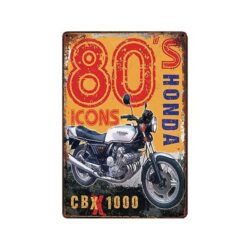
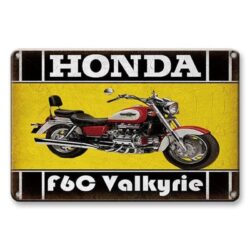
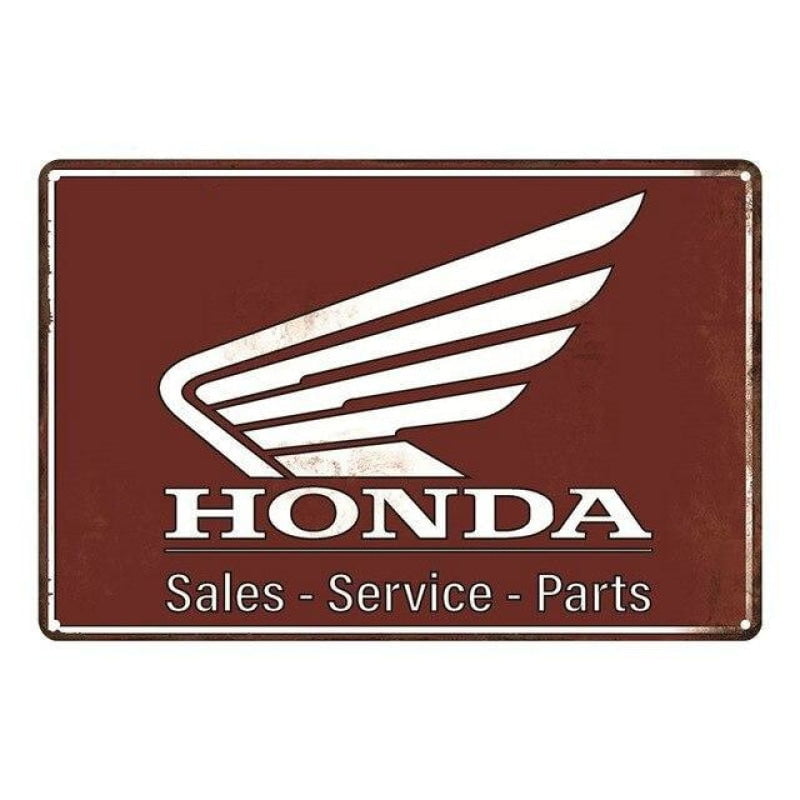

All motorcycle fans must have this Honda Metal Sign! Its vintage look will blend perfectly with your decor thanks to its unique style.
- ⚡ WHEN YOU PURCHASE TWO VINTAGE METAL PLATES, THE 3RD IS FREE! ⚡
- Materials:
- Metal protected against corrosion, built to last.
- Very light and easy to install.
- Packaged carefully and placed in a shock-resistant package for safe transport.
- Size: 20 (W) × 30 (L) cm / 30 (W) × 40 (L) cm.
- FREE SECURE DELIVERY & SHIPPED WITHIN 48/72 HOURS (see our FAQs).
Description of this Honda Metal Sign
The Honda Motor Company, Ltd. (Japanese: 本田技研工業株式会社, Hepburn: Honda Giken Kōgyō KK, IPA: (About this soundlisten); /ˈhɒndə/) is a Japanese public multinational conglomerate manufacturer of automobiles, motorcycles, and power equipment, headquartered in Minato, Tokyo, Japan.
Honda has been the world’s largest motorcycle manufacturer since 1959, reaching production of 400 million by the end of 2019, as well as the world’s largest internal combustion engine manufacturer measured by volume, producing over 14 million internal combustion engines each year. Honda became the second-largest Japanese automaker in 2001. Honda was the eighth-largest automaker in the world in 2015.
Honda was the first Japanese automaker to launch a dedicated luxury brand, Acura, in 1986. In addition to its core automobile and motorcycle businesses, Honda also manufactures lawn and garden equipment, marine engines, personal watercraft, and generators, among other products. Since 1986, Honda has been involved in research into artificial intelligence and robotics and launched its ASIMO robot in 2000. It has also ventured into aerospace with the establishment of GE Honda Aero Engines in 2004 and the Honda HA-420 HondaJet, which began production in 2012. Honda has two joint ventures in China: Dongfeng Honda and Guangqi Honda.
In 2013, Honda invested approximately 5.7% (US$6.8 billion) of its revenue in research and development. Also in 2013, Honda became the first Japanese automaker to be a net exporter from the United States, exporting 108,705 Honda and Acura models, while importing only 88,357.
The History of Honda
Throughout his life, Honda’s founder Soichiro Honda was interested in automobiles. He worked as a mechanic at Art Shokai Garage, where he tuned cars and entered them in races. In 1937, with financing from his acquaintance Kato Shichirō, Honda founded Tōkai Seiki (Eastern Sea Precision Machine Company) to manufacture piston rings working out of Art Shokai Garage. After initial failures, Tōkai Seiki won a contract to supply piston rings to Toyota, but lost the contract due to the poor quality of their products. After attending engineering school without graduating, and visiting factories around Japan to better understand Toyota’s quality control processes known as the “Five Whys,” in 1941, Honda was able to mass-produce piston rings acceptable to Toyota, using an automated process that could employ even unskilled workers in wartime.:16–19
Tōkai Seiki was placed under the control of the Ministry of Trade and Industry (called the Ministry of Munitions after 1943) at the outbreak of World War II, and Soichiro Honda was demoted from president to senior managing director after Toyota took a 40% stake in the company. Honda also aided the war effort by assisting other companies in automating the production of military aircraft propellers. The relationships Honda cultivated with personnel at Toyota, Nakajima Aircraft Company, and the Imperial Japanese Navy would be instrumental in the postwar era. A US B-29 bomber attack destroyed Tōkai Seiki’s Yamashita factory in 1944, and the Itawa factory collapsed on January 13, 1945. Soichiro Honda sold the salvageable remains of the company to Toyota after the war for ¥450,000 and used the proceeds to found the Honda Technical Research Institute in October 1946. With a staff of 12 men working out of a 16 m² (170 sq ft) shack, they built and sold improvised motorized bicycles, using power from 500 war-surplus Tohatsu 50 cc two-stroke radio generator engines. When the engines ran out, Honda began building their own copy of the Tohatsu engine, and supplying these to customers to attach to their bicycles. This was the Honda A-Type, nicknamed the Bata Bata for the sound the engine made. In 1949, the Honda Technical Research Institute was liquidated for 1,000,000 yen, or about US$5,000 today; these funds were used to incorporate Honda Motor Co., Ltd.:21 At about the same time, Honda hired engineers Kihachiro Kawashima and Takeo Fujisawa, who provided much-needed sales and marketing expertise to complement Soichiro Honda’s technical expertise.:21 The close partnership between Soichiro Honda and Fujisawa lasted until they stepped down together in October 1973.:21
The first complete motorcycle, with both the chassis and engine manufactured by Honda, was the 1949 D-Type, the first Honda to bear the Dream name. In 1961, Honda achieved its first Grand Prix victories and World Championships in 125cc and 250cc. Honda Motor Company grew in a short time to become the world’s largest manufacturer of motorcycles by 1964.
Honda’s first production automobile was the T360 minivan, which went on sale in August 1963. Powered by a small 356-cc straight-4 gasoline engine, it was classified under the cheaper Kei Car tax bracket. The first production car from Honda was the S500 sports car, which followed the T360 into production in October 1963. Its chain-driven rear wheels indicated Honda’s motorcycle origins.
Over the next few decades, Honda worked to expand its product line and expand its operations and exports to many countries around the world. In 1986, Honda introduced the successful Acura brand to the American market in an effort to gain ground in the luxury vehicle market. The year 1991 saw the introduction of the Honda NSX supercar, the first all-aluminum unibody vehicle to incorporate a mid-engine V6 with variable valve timing.
CEO Tadashi Kume was replaced by Nobuhiko Kawamoto in 1990. Kawamoto was selected by Shoichiro Irimajiri, who oversaw the successful establishment of Honda of America Manufacturing, Inc. in Marysville, Ohio. Irimajiri and Kawamoto shared a friendly rivalry within Honda; due to health issues, Irimajiri would resign in 1992.
Following the death of Soichiro Honda and the departure of Irimajiri, Honda quickly found itself overtaken in product development by other Japanese automakers and caught off guard by the truck and sport utility vehicle boom of the 1990s, all of which hurt the company’s profitability. Japanese media reported in 1992 and 1993 that Honda was seriously at risk of an unwanted and hostile takeover by Mitsubishi Motors, which at the time was a larger automaker by volume and brimming with profits from its successful Pajero and Diamante models.
Kawamoto acted quickly to change Honda’s corporate culture, rushing through market-driven product development that resulted in recreational vehicles such as the first-generation Odyssey and CR-V, and a refocusing away from some of the many sedans and coupes that were popular with the company’s engineers but not with the buying public. The most shocking change for Honda came when Kawamoto ended the company’s successful participation in Formula One after the 1992 season, citing costs in light of the threatened Mitsubishi takeover as well as a desire to create a more environmentally friendly corporate image.
The Honda Aircraft Company was established in 2006 as a wholly owned subsidiary to manufacture and sell the HondaJet family of aircraft. First deliveries to customers began in December 2015.
On February 23, 2015, Honda announced that CEO and President Takanobu Ito would resign and be replaced by Takahiro Hachigo by June; Additional retirements by senior executives and directors were expected.
In October 2019, Honda reportedly held talks with Hitachi to merge the two companies’ auto parts businesses, creating a component supplier with nearly $17 billion in annual sales.
In January 2020, Honda announced it would retire its employees working in Wuhan, Hubei, China due to the COVID-19 pandemic. Due to the global spread of the virus, Honda became the first major automaker with operations in the US to suspend production in its factories on March 23, 2020. It resumed automobile, engine, and transmission production at its US plants on May 11, 2020.
Honda and General Motors announced a North American alliance in September 2020 that will begin in 2021. According to the Detroit Free Press, “the proposed alliance will include sharing a range of vehicles, which will be sold under each company’s separate brands, as well as cooperation on purchasing, research and development, and connected services.”