


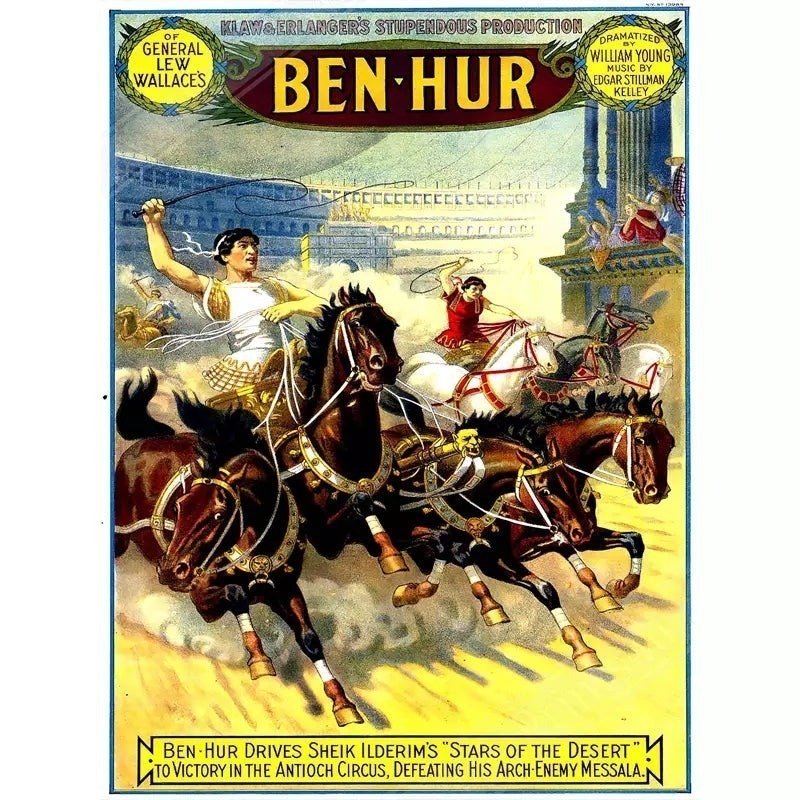





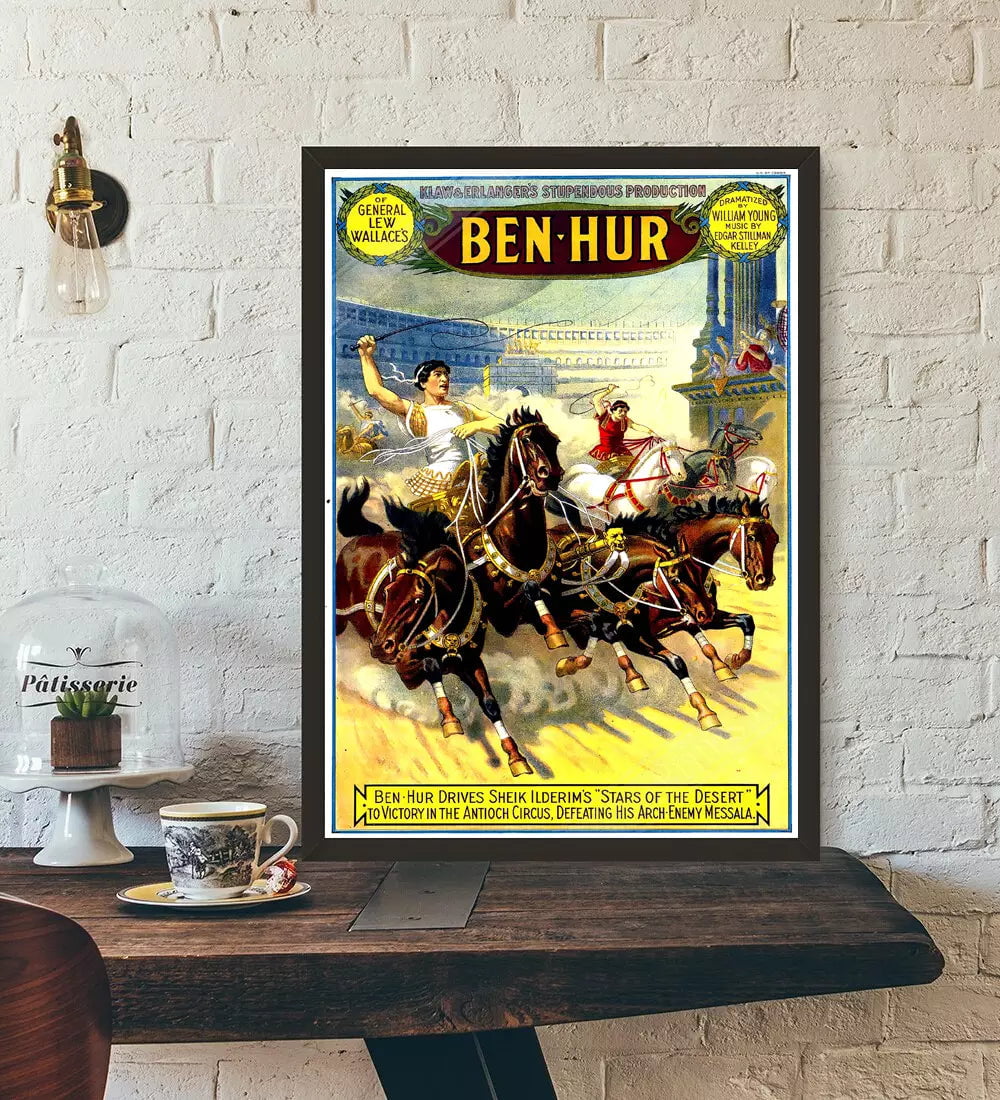

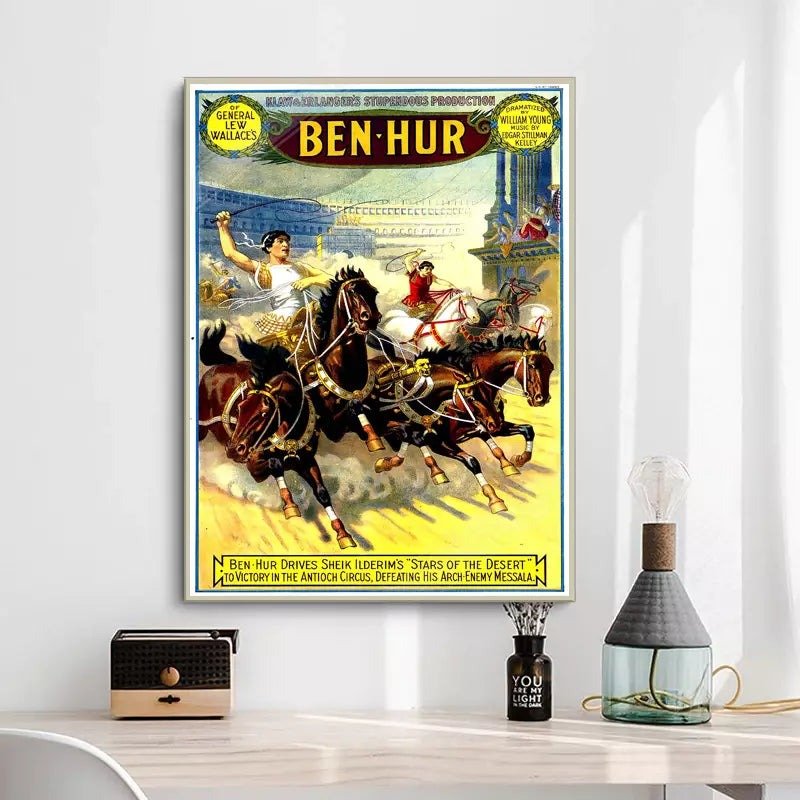

























With this Ben-Hur Poster, immerse yourself in a timeless and captivating epic. This cinematic masterpiece, imbued with intense emotions and thrills, transports you to a world of thrilling adventures and intertwined destinies. Follow the tormented destiny of Judah Ben-Hur, a man of noble lineage caught in a spiral of betrayal, revenge, and redemption. Between grandiose scenes of chariot races, epic battles, and emotional confrontations, this iconic film offers an unforgettable visual and narrative experience. Let yourself be swept away by the scale of the sumptuous sets, the depth of the characters, and the incredible intensity of the performances. Discover a cinematic fresco of striking beauty, where heroism, love, loyalty, and the quest for justice intertwine. The “Ben-Hur Poster” is more than just a movie, it’s an epic journey through universal emotions and values that will stay with you long after the screening is over.
- Paper Feature:
- 🎨 Canvas: global standard in terms of printing and imitating a “painting canvas” look.
- By default, the poster contains a 4cm white border for framing (frame not included). If you don’t want it, please choose “without white border”.
- ✅ Size: Multiple choices available. ✅
- High UV resistance.
- Color vibrancy maximum, glare-free.
- Paper recycled, guaranteeing environmental friendliness.
- Poster packaged carefully and delivered in a protective tube for Total protection.
- FREE STANDARD DELIVERY.
⚠️ Frame not included. ⚠️
Description of this Ben-Hur Poster
Ben-Hur is a monumental 1959 American film directed by William Wyler, based on the eponymous novel by Lew Wallace. Charlton Heston plays the title role of the Israelite prince Judah Ben-Hur, whose conflict with his former friend Messala (Stephen Boyd) has tragic consequences. The film set numerous production records and notably won eleven Academy Awards. This mark, which Ben-Hur still shares with the films Titanic and The Lord of the Rings: The Return of the King, remains unmatched to this day.
With a budget of $15 million (approximately $139 million today), Ben-Hur is—after adjusting for inflation—among the most expensive productions in cinematic history. The film premiered on November 18, 1959, in New York City. This monumental film ranks 14th on the list of most successful films in American theaters—adjusted for inflation—behind Star Wars: The Empire Strikes Back and ahead of Avatar.
The film depicts the life of the fictional Jewish prince and merchant Judah Ben-Hur, who, in the 8th century BC, lives in Jerusalem as a contemporary of Jesus Christ. The film’s prologue depicts the birth of Jesus.
In the year 26 after the birth of Christ, Judah Ben-Hur’s childhood friend, Messala the Tribune, who saved his life, becomes a commander in Jerusalem and is ready to nip every act of rebellion in the bud. The joy of the reunion is great for Judah, his mother Miriam, and his sister Tirzah and Messala. However, the years of separation have shaken their friendship. It quickly becomes clear that the two men’s lives have taken opposite turns. While Judah feels attached to his family and home, Messala has developed an unquestioning military conscience. He believes he must assert the interests of the Roman Empire regardless of losses. He accepts the most serious violations of the law and believes he can win Judah over for this. After a close friend of Judah gave the old friend a valuable Arabian horse, Messala asked him to name all the influential people who had criticized Rome’s rule in Judea. Judah refused to accept such a request. Messala, however, did not give in and gave him a choice: “Either you are for me or against me.” Judah replied without hesitation: “If that is the choice, then I am against you!” Severely disappointed and in a fight, Messala immediately left his friend’s estate, thus offending Miriam and Tirzah, who were preparing the banquet.
When Judah’s administrator, Simonides of Antioch, appears on the annual accountability report, his daughter Esther was also there, as she was planning an arranged marriage with a merchant. Judah inherited Simonides as his father’s slave, and thus also his daughter. However, Judah makes it clear that he has no intention of slavery or serfdom and considers Simonides a friend of the house. For the marriage, she must ask her master’s permission, and Judah gives her freedom as a wedding gift. However, the two have known each other since childhood and have feelings for each other.
Judah is still single because he has not yet found a woman he loves. The day before the terrible events that follow, the two confess their love for each other. Judah takes Esther’s “slave ring” and places it on his little finger, at the same time vowing to wear this ring until he finds the woman he wants to marry.
When the new governor, Valerius Gratus, takes office in Jerusalem, Judah and Tirzah watch the parade in his honor from the rooftop terrace of their house. Just as Gratus climbs among them, Tirzah leans over the parapet, causing some loose tiles to fall and immediately strike Gratus. Gratus’s horse bolts and throws its rider. Roman soldiers then invade the Judah Ben-Hur family home. Against his better knowledge, Messala accuses his childhood friend Judah of an assassination attempt and has him and his family imprisoned. Only then does Messala verify the facts of this supposed assassination attempt on the roof terrace and become convinced that other bricks in the area of the accident site are actually loose. It must therefore be clear to him that if he maintains his accusation, he is wrong.
While still in prison, Judah vows revenge on Messala. When the administrator Simonides hears of the arrest, he tries to defend Judah, but he too is arrested during his conversation with Messala. He is tortured and then released as a physically disabled person. Judah is found guilty, convicted, and sent from Messala to Tyre to the galley.
On the march to the galley in Tyre accompanied by Roman soldiers, Judah and other prisoners must cross a desert. Everyone is allowed to drink during a rest in Nazareth; only Judah is denied water. A carpenter unknown to him—Jesus—gives him water to drink. The officer leading the slave train initially wants to prevent this, but refrains from doing so when he faces the stranger face to face.
After three seemingly terrible years in the galley, Judah, who has been chained to his bank, meets the commander of the fleet, the new consul Quintus Arrius. Not long ago, he lost his son, the ancestor of his family. He hides his grief behind a forcefully tough exterior and pessimistic fatalism. Arrius is thus impressed by the unwavering vital energy and rebellion he recognizes in Ben-Hur. The commander, Judah, who is only called to the galley as a convict with “41,” his oarsman’s number, calls him into the cabin and offers him a new life as a gladiator or charioteer in the arena. Judah, recognizing Arrius’s emotional agony, rejects this and is sent back to his helm below decks. When the expected naval battle with Macedonian pirates is imminent, Arrius welds Judah together as an act of mercy. The galley is sunk in battle. In this situation, Judah tries to free as many of his fellow prisoners as possible and also saves the commander, who has fallen into the water from drowning. Judah drags Arrius to a wreck and chains Arrius to it when he tries to commit suicide. Even when Judah realizes that it will be a Roman ship that will save her—and her slave labor will therefore continue—he surrenders to this fate. After the two shipwrecked men have been taken on board the trireme, Arrius learns that the Battle of Rome has been victorious. He gratefully leaves his Savior Judah with the first sip from the cup of water given to him.
Arrius is honored with a triumphal procession. He has received the general staff from the hand of Emperor Tiberius. With the triumphant approval, the emperor has obtained information about Judah. Indirectly, Tiberius had expressed doubts about the guilt of the condemned. Therefore, he gives Judah’s slave to the fleet commander. Arrius is now supposed to decide his ward’s fate himself. To Arrius, Judah becomes a prosperous and well-known charnel house in the Circus Maximus. The new Sportidol lives in the circle of the Roman elite—full of worries that his mother and sister will never see again. Months later, Arrius adopted Judah, for whom he has developed paternal feelings. At a glamorous festival, he announced that Judah was now also the bearer of his name and the heir to his wealth. In front of the guests present, Arrius hands his signet ring to Judah, who is visibly touched. In a short speech, Judah acknowledged the wish to wear the ring honorably and with great gratitude. At this festival, Arrius and Judah learn that an acquaintance of the fleet commander, Pontius Pilate, who himself owns a racing team, has been appointed governor in Judea. Pilate, who really wanted to go to Alexandria, cannot gain anything good from his new position. However, thanks to his acquaintance with Pilate, Arrius sees a way to correct the injustice that has befallen Judah. But his adopted son fears he will be late if he stays in Rome any longer. So Arrius wistfully lets him go to Jerusalem.
On his return journey, Judah meets Balthasar of Alexandria, an old man who was searching for the Redeemer of Nazareth and wanted to be there when he began his work. He says he once followed a star to Bethlehem and saw a newborn baby in whom he believed God lived. Balthasar’s host is the Arab sheikh Ilderim, a true “horse idiot” who trains his horses for chariot races. Ilderim, who also calls his horses (Lipizzaner) his “children,” has named them after stars. The sheikh is impressed by Judah’s ability to handle horses and tries to convince him to enter a race in the Jerusalem circus as a charioteer. There, he would defeat the favorite, Messala Tribune (Master of the East). Sheikh Ilderim immediately notices that Judah still has a bill with him. However, Judah initially refuses. He is determined to kill Messala and continues.
From Esther, who happily welcomes him to Jerusalem, he learns that the Hur family fortune has been confiscated and Esther is hiding with her father. Judah—as the consul’s adopted son—appears to a surprised Messala in a purple-lined toga of the upper senatorial class and demands to find out what happened to his mother Miriam and his sister Tirzah. To emphasize his request, Judah presses the image of the signet ring, which he received from Quintus Arrius, into a wax tablet and throws it onto the table in front of Messala, requesting not to disappoint him. On Messala’s behalf, they search for the two in prison. When they are found in their underground dungeon, it turns out that both have leprosy, which is why they are immediately removed from the dungeon. They want to enter the Valley of the Leper, but before doing so, they go to Esther and ask them not to tell Judah about their existence and their illness, so that he will remember them as they were. In tears, Esther promises not to tell Judah about her encounter.
When Judah returns agitated from visiting Messala, Esther claims to have seen her mother and sister dead in the dungeon. Judah refuses to believe this and continues to rage at Messala. Judah now remembers the conversation with Sheikh Ilderim, who told him that there were no rules in the arena and that many men would also be killed in chariot races.
Judah participates with Ilderim’s horses in the race, which he sees as an opportunity to take revenge on Messala. Messala drives a “Greek” carriage, the wheel hubs of which have sharp milling machines mounted externally. He thus causes accidents and knocks down several teams by closing in on competing wagons and destroying their spokes with the milling machines. Judah barely escapes such attacks. When the wheels of both carriages jam in a renewed attack on the penultimate lap, Messala initially whips Judah. When he snatches the whip from him in the developing race and at the same time the jammed wagons loosen with a powerful jerk, Messala falls from the wagon and is dragged along by his roaring team. Finally, the Roman falls under the hooves of the following teams and is seriously injured. Judah wins the race. Dying, Messala tells Judah that his mother and sister are not dead—he should look for them in the Valley of the Leper. When Judah looks for them there, he meets Esther, who is currently bringing them food. With difficulty, she is able to prevent Judah from making himself known to Miriam and Tirzah.
Judah is still inspired by revenge; Esther, on the other hand, follows the words of peace preached by a man from Nazareth named Jesus and calls on Judah to lay aside his hatred. When she returns to the Valley of the Leper and Judah surprisingly appears, they decide to bring Miriam and Tirzah to Jesus. In the city, however, they are dismayed to learn that this is being tested. On the next Stations of the Cross, Judah recognizes Jesus as the man who gave him water to drink in Nazareth. When Jesus falls to the ground beneath his cross, Judah in turn wants to give him water to drink, but is rebuffed by a Roman soldier.
Judah is the affected witness to Jesus’ crucifixion. Balthasar does not interpret the event as an end, but as a beginning. A great storm occurs during Jesus’ death; Miriam and Tirzah are healed of their leprosy by a divine miracle. At home, Judah Esther, visibly moved, recounts Jesus’ final request on the cross: forgiveness for his executioners, who knew not what they were doing. He also literally assures that he felt Jesus’ words “take the sword from his hand” and that he would refrain from taking revenge. In the “final blow,” Judah meets his mother and sister, both healed of the terrible, then incurable disease. With tears in his eyes, Judah embraces his newfound family and begins a new future with them.