
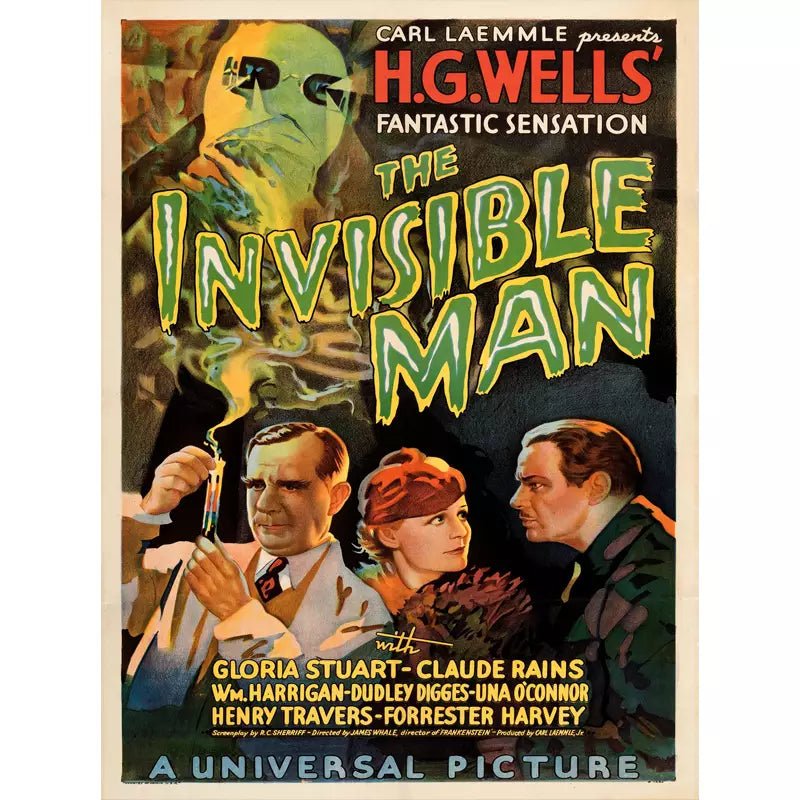
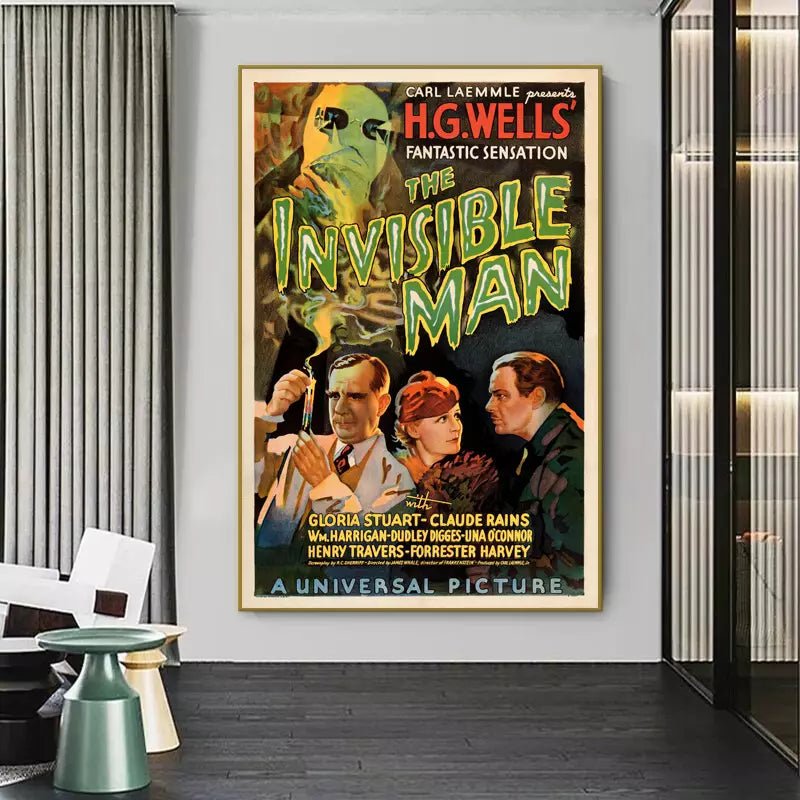
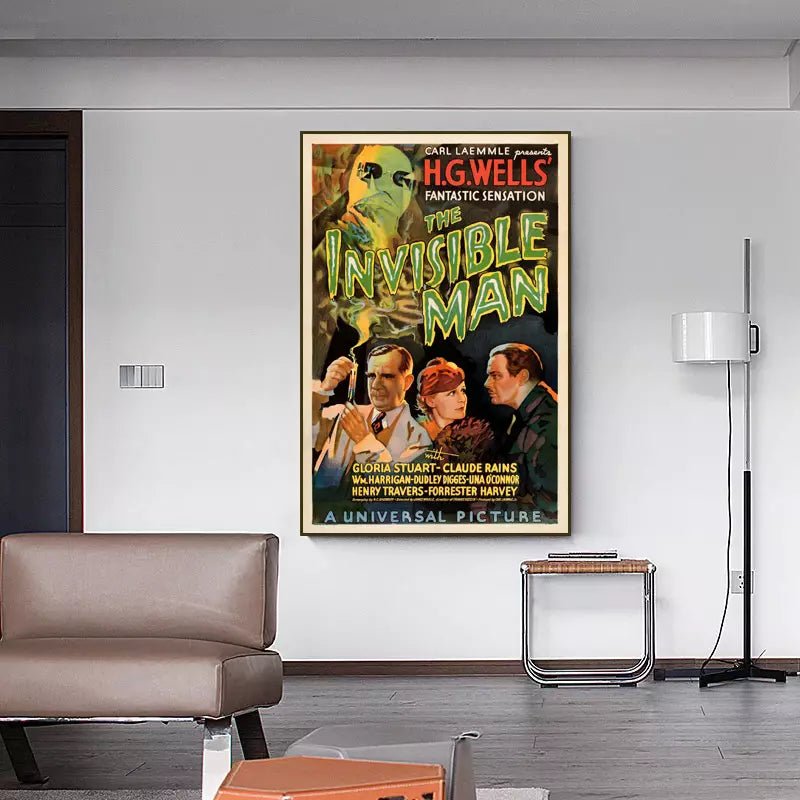
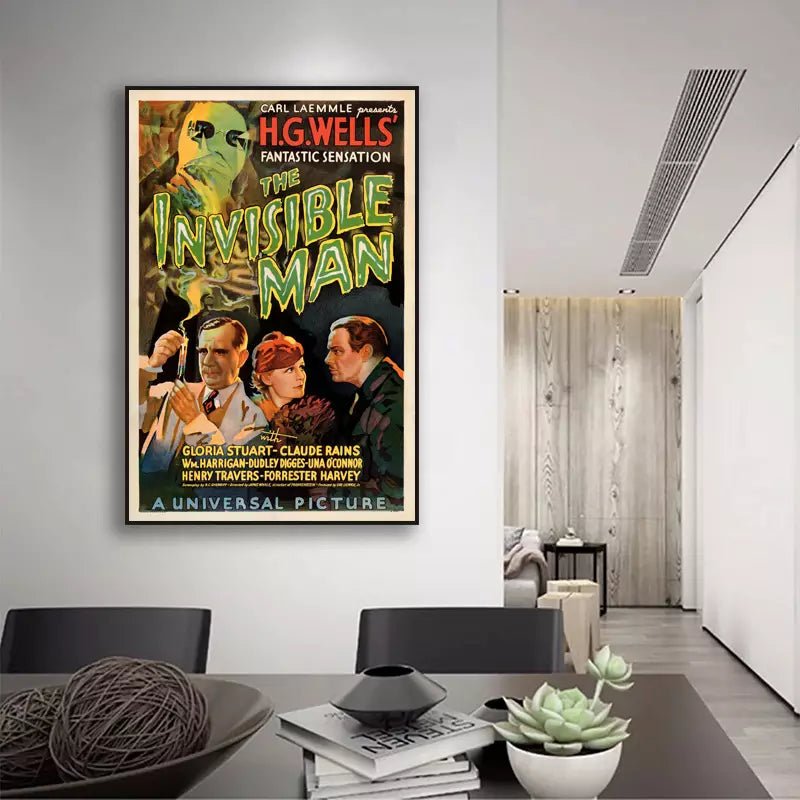
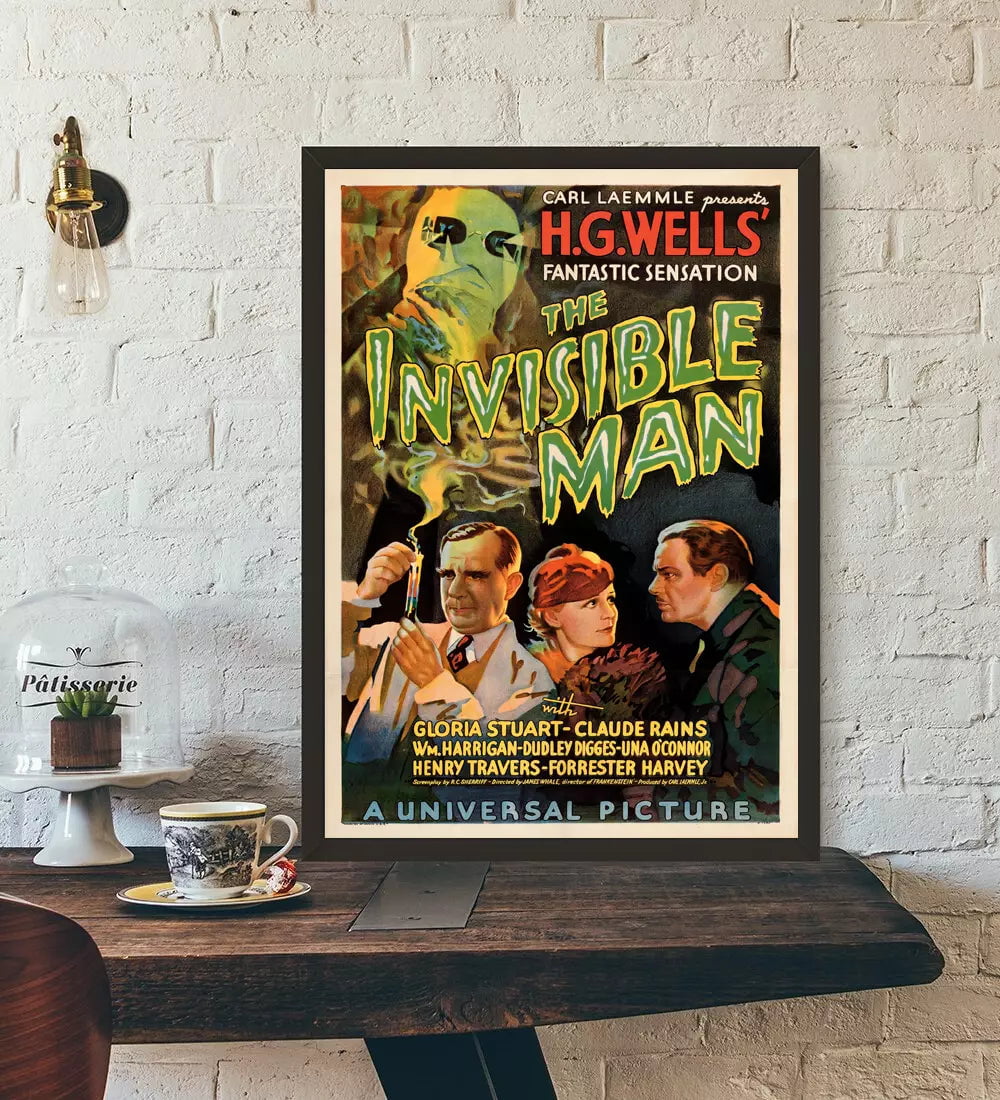
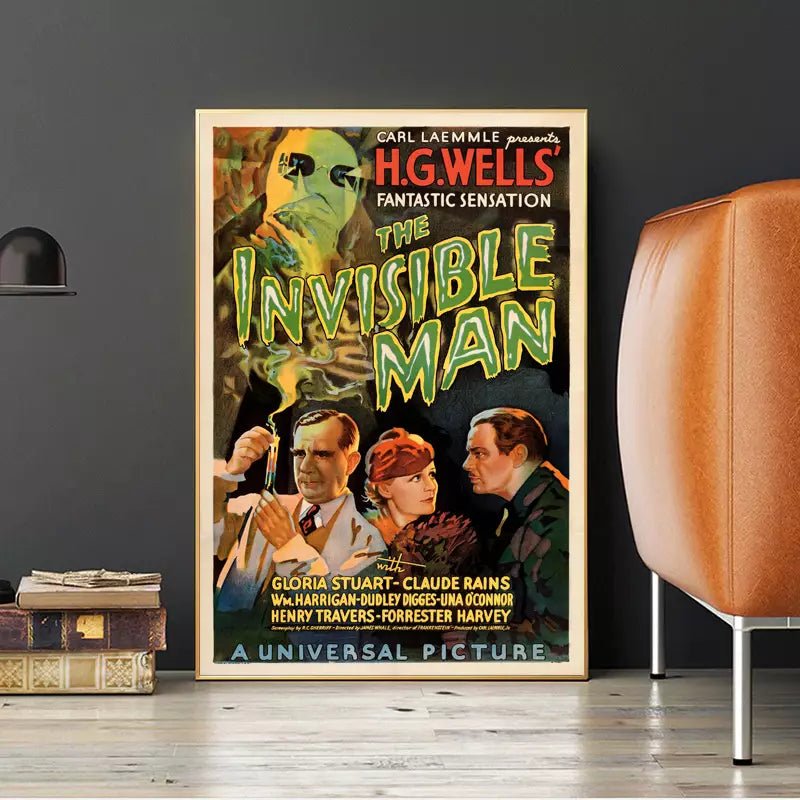
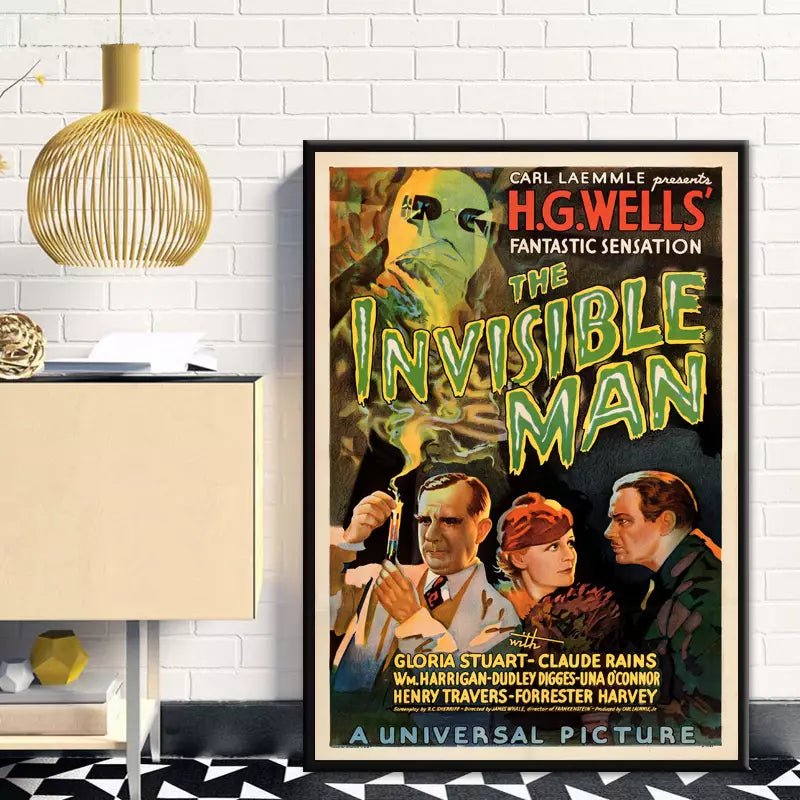
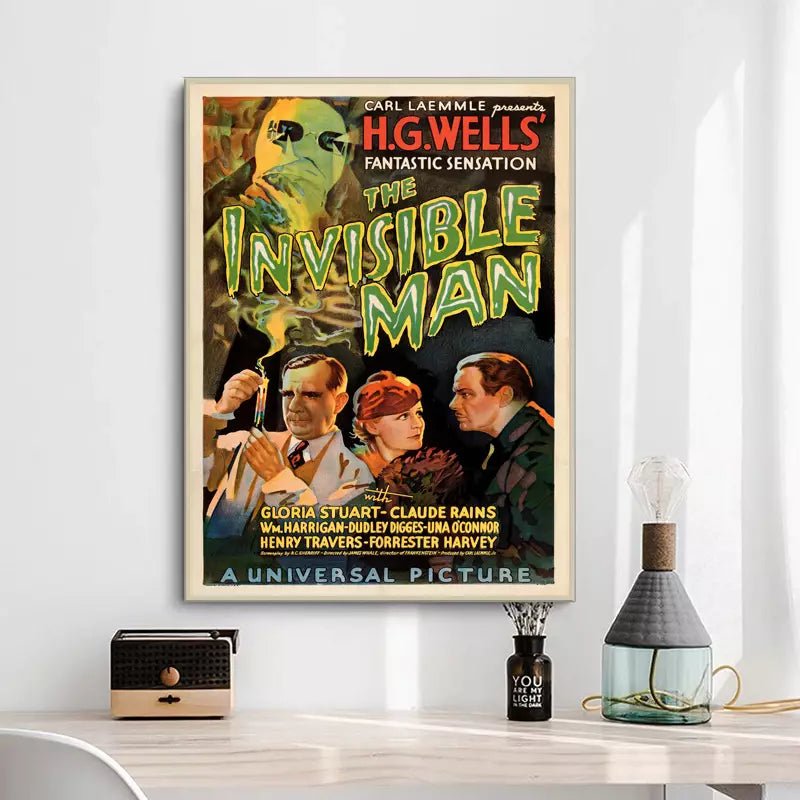
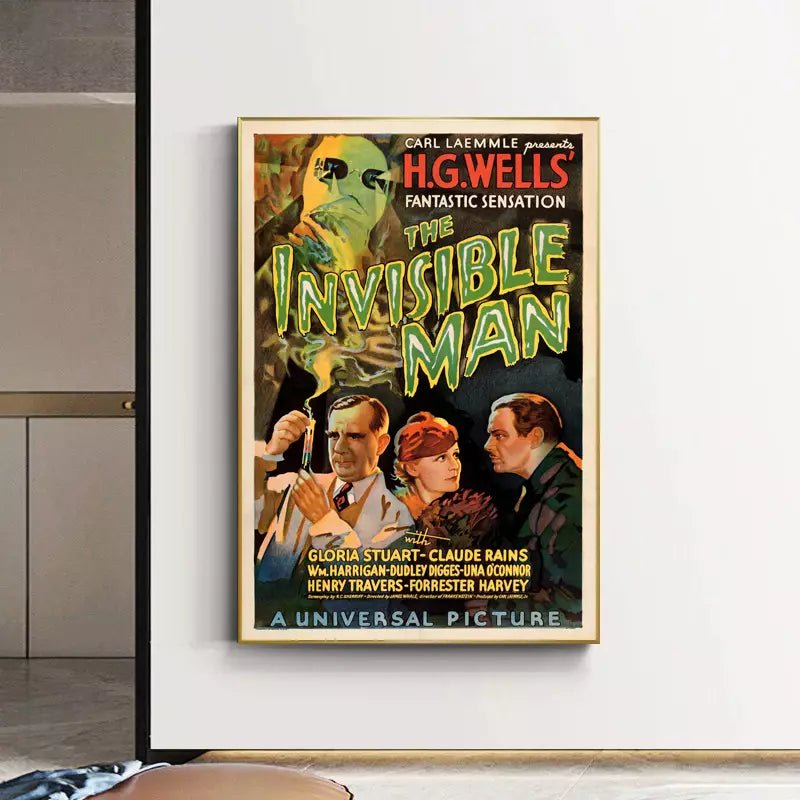
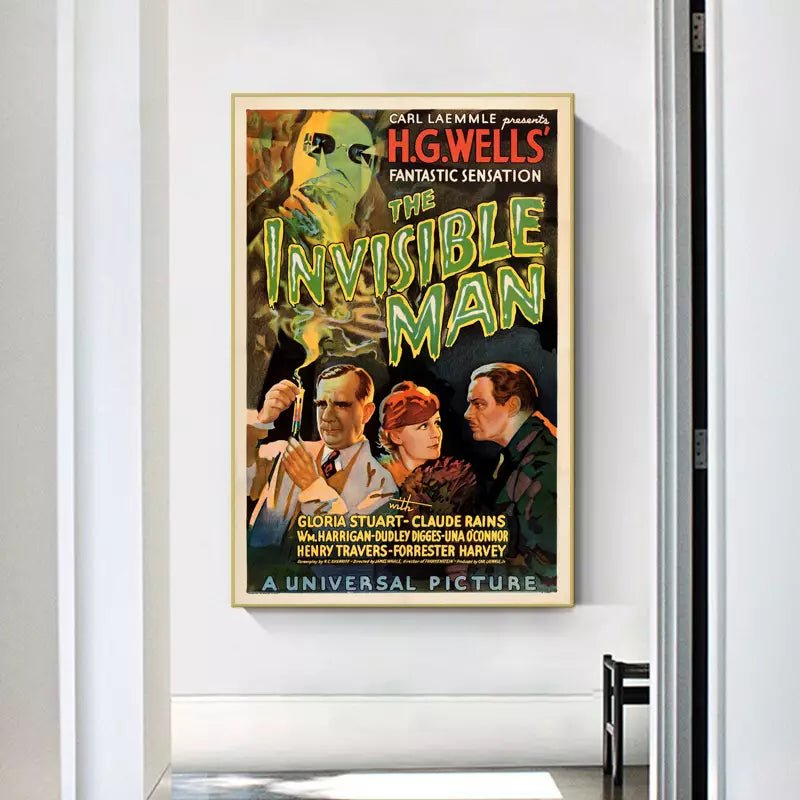
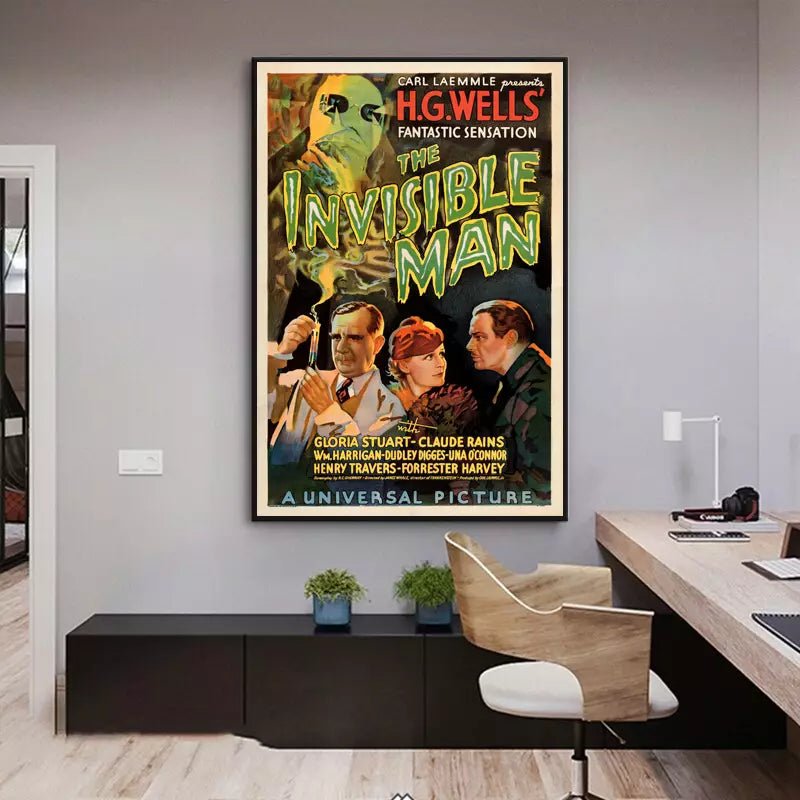
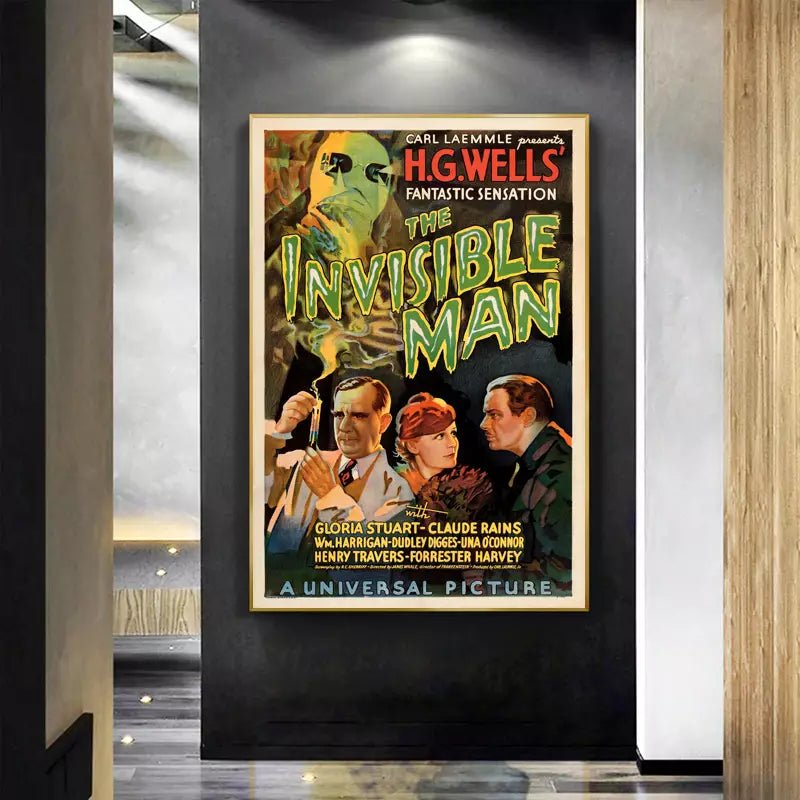



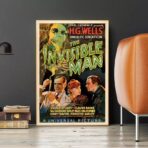



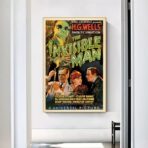











Dive into a gripping thriller with this The Invisible Man Poster. An intriguing poster for a film that will send shivers down your spine. Follow the captivating story of a woman stalked by her violent ex, who has become invisible.
- Paper Feature:
- 🎨 Canvas: global standard in terms of printing and imitating a “painting canvas” look.
- By default, the poster contains a 4cm white border for framing (frame not included). If you don’t want it, please choose “without white border”.
- ✅ Size: several choices available. ✅
- High UV resistance.
- Maximum color brilliance without reflections.
- Recycled paper guaranteed environmental friendliness.
- Poster wrapped carefully and delivered in a protective tube for total protection.
- FREE STANDARD DELIVERY.
⚠️ Frame not included. ⚠️
Description of this Poster The Invisible Man
The Invisible Man is a 1933 American science fiction horror film directed by James Whale and based on the 1897 novel The Invisible Man by H. G. Wells. It was produced by Universal Pictures and starred Gloria Stuart, Claude Rains, and William Harrigan. The film features Dr. Jack Griffin (Rains), covered in bandages and with his eyes obscured by dark glasses, the result of a secret experiment that renders him invisible, who takes up residence in the village of Iping. Never leaving his lodgings, the stranger demands that the staff leave him completely alone until his landlady discovers he is invisible. Griffin returns to the laboratory of his mentor, Dr. Cranley (Henry Travers), where he reveals his secret to Dr. Kemp (William Harrigan) and his former fiancée, Flora Cranley (Gloria Stuart), who soon learn that Griffin’s discovery has driven him mad, prompting him to prove his superiority over others by playing harmless pranks and then committing murder.
The Invisible Man was in development for Universal as early as 1931, when Richard L. Schayer and Robert Florey suggested that Wells’s novel would make a good sequel to the studio’s hit horror film, Dracula. Universal opted to make Frankenstein in 1931. Several screenplay adaptations were then written, and a number of potential directors, including Florey, E.A. Dupont, Cyril Gardner, and screenwriters John L. Balderston, Preston Sturges, and Garrett Fort, all signed on to develop the project, with the intention of making it into a film for Boris Karloff. After working on The Old Dark House with Karloff and The Kiss Before the Mirror, Whale signed on, and fellow screenwriter R.C. Sherriff developed a script in London. Production began in June 1933 and ended in August, with two months of special effects work following the end of filming.
Upon its release in 1933, the film was a major financial success for Universal and received good reviews from several trade publications, including The New York Times, which named it among the best films of 1933. The film spawned several sequels that had little to do with the original film in the 1940s. The film continued to receive praise in re-evaluations by critics such as Carlos Clarens, Jack Sullivan, and Kim Newman, and was cited as one of their favorite genre films by filmmakers John Carpenter, Joe Dante, and Ray Harryhausen. In 2008, The Invisible Man was selected by the Library of Congress for inclusion in the United States National Film Registry because of its cultural, historical, or aesthetic significance.
On a snowy night, a stranger, his face covered in bandages and his eyes hidden by dark glasses, takes a room at the Lion’s Head Inn in the English village of Iping, Sussex. The man asks to be left alone. Later, the innkeeper, Mr. Hall, is sent by his wife to evict the stranger, who has made a huge mess of his room while researching and is behind on his rent. Enraged, the stranger throws Mr. Hall down the stairs. Confronted by a police officer and some local civilians, he removes his bandages and glasses, revealing that he is invisible. Laughing out loud, he strips naked, making himself completely undetectable, and chases his tormentors away before fleeing into the countryside.
The stranger is Dr. Jack Griffin, a chemist who has discovered the secret of invisibility by conducting a series of tests on an obscure drug called monocane. Flora Cranley, Griffin’s fiancée and the daughter of his employer, Dr. Cranley, is concerned about Griffin’s long absence. Cranley and his other assistant, Dr. Kemp, search Griffin’s empty laboratory and find only a single note in a cupboard. Cranley becomes concerned when he reads it. The note contains a list of chemicals, including monocane, which Cranley knows to be extremely dangerous; an injection of it drove a dog mad in Germany. Griffin, it seems, is unaware of this. Cranley deduces that Griffin may have learned about the monocane from English books printed before the incident, which only describe its bleaching power.
The night of his escape from the inn, Griffin shows up at Kemp’s house. He forces Kemp to become his visible partner in a plot to dominate the world through a reign of terror, starting with “a few murders here and there.” They return to the inn to retrieve his notebooks on the invisibility process. Sneaking inside, Griffin discovers that a police investigation is underway, led by a civil servant who believes it to be a hoax. After putting his books away, Griffin angrily attacks and kills the officer.
Back home, Kemp calls Cranley for help, then the police. Flora persuades her father to let her accompany him. In her presence, Griffin becomes calmer and calls her “darling.” When he realizes that Kemp has betrayed him, his first reaction is to lead Flora away from danger. After promising Kemp he’ll kill him at 10:00 the following evening, Griffin escapes and goes on a murder spree. He causes a train to derail, killing about 100 people, and throws two volunteer searchers off a cliff. The police offer a reward to anyone who can find a way to catch him. Sensing that Griffin will try to keep his promise, the chief inspector in charge of the search uses Kemp as bait and sets up various clever traps. At Kemp’s insistence, the police disguise him in a police uniform and let him drive his car away from his house. Griffin, however, hides in the backseat of the car, surprising Kemp and revealing that he has also been following him all day while he committed his crimes. He overpowers Kemp and straps him into the front seat. Griffin then sends the car down a steep hill and off a cliff where it instantly explodes, killing Kemp.
A snowstorm forces Griffin to take refuge in a barn where he falls asleep. Later, a farmer enters and sees movement in the hay where Griffin is sleeping. He alerts the police, who rush to the farmhouse and surround the barn. They set fire to the building, forcing Griffin to get out, leaving visible footprints in the snow. The chief detective opens fire, mortally wounding Griffin. He is taken to the hospital where, hours later, a surgeon informs Dr. Cranley that Griffin is dying and asks to see Flora. On his deathbed, Griffin remorsefully confesses to Flora, “I have meddled in things a man ought to leave alone.” As he dies, his body quickly becomes visible again.