


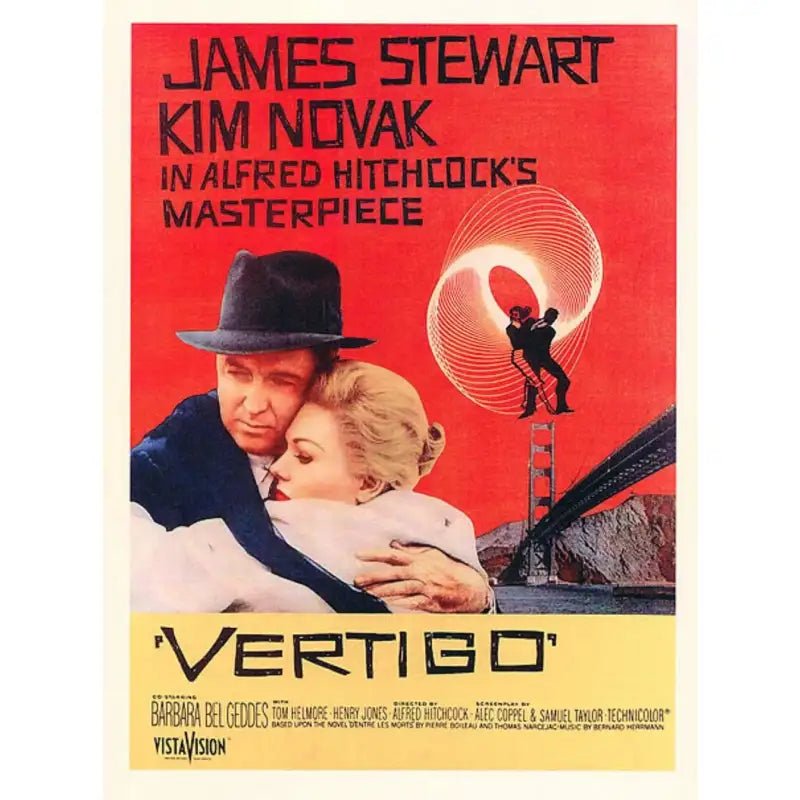
























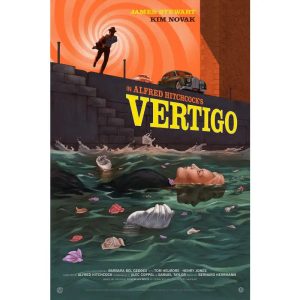








Discover this Vertigo Poster, one of Alfred Hitchcock’s most famous films that will add a little thrill to your decor.
- Paper Feature:
- 🎨 Canvas: global standard in terms of printing and imitating a “painting canvas” look.
- By default, the poster contains a 4cm white border for framing (frame not included). If you don’t want it, please choose “without white border”.
- ✅ Size: Multiple choices available. ✅
- High UV resistance.
- Color vibrancy maximum, glare-free.
- Paper recycled, guaranteeing environmental friendliness.
- Poster packaged carefully and delivered in a protective tube for Total protection.
- FREE STANDARD DELIVERY.
⚠️ Frame not included. ⚠️
Description of this Vertigo Poster
Vertigo is a 1958 American psychological thriller film directed by Alfred Hitchcock and starring James Stewart and Kim Novak. The screenplay is based on the novel D’entre les morts (1954) by Pierre Boileau and Thomas Narcejac.
The film, which received some reservations from critics and audiences upon its initial screening, is now one of the director’s most important works. In the British magazine Sight & Sound’s ten-yearly critical survey of the “greatest films of all time,” the film was ranked first in the 2012 list by over 800 film critics.
The plot follows John “Scottie” Ferguson, a retired police officer, who falls in love with a suicidal woman but is unable to prevent her death due to his fear of heights. Later, when he meets a young woman who looks exactly like the deceased, he attempts to transform her into the image of his late love.
While chasing a criminal across the rooftops of San Francisco, police officer John “Scottie” Ferguson finds himself in a perilous situation: he slips on a tiled roof and grabs the gutter at the last minute. A colleague who tries to help him falls to his death. Scottie leaves the department due to a vertigo diagnosis and feelings of guilt. His longtime platonic friend, Midge Wood, tries to support him in this new phase of his life.
Scottie’s former classmate, Gavin Elster, asks him to follow his wife, Madeleine. Elster is worried about his wife, who seems to be possessed by the spirit of her late great-grandmother, Carlotta Valdes. She committed suicide at the age of 26; According to Elster, Madeleine, also 26, increasingly feels the need to imitate him. She wears the same hair as Carlotta and regularly visits her grave as well as the California Palace of the Legion of Honor, where a portrait of her hangs. In addition, she has rented a room in the last hotel Carlotta stayed at. Scottie follows Madeleine to Fort Point, and when she jumps into San Francisco Bay, he saves her from drowning and takes her to his home. The next day, Madeleine brings Scottie a thank-you note, and they decide to spend the day together. They go to Muir Woods and Cypress Point on 17-Mile Drive, where Madeleine walks down to the sea. Scottie grabs her, and they hug. The next day, Madeleine visits Scottie and tells him about a nightmare. At the center of the dream is the old Spanish mission of San Juan Bautista, Carlotta’s childhood home. He takes her there, and they express their love for each other. Madeleine suddenly rushes into the church and up the bell tower. Scottie, stopped on the steps by his dizziness, sees Madeleine rushing to her death. The investigating judge attributes to him—even though he is innocent in the legal sense of the term—part of the responsibility for her death. Scottie sinks into depression and is committed to a psychiatric hospital.
Recovered, but scarred by the death of his beloved, Scottie some time later meets Judy, a young saleswoman who bears a striking resemblance to Madeleine. In fact, they are one and the same person: Judy had pretended to be Madeleine, Elster’s wife, so that he could murder the real one. Since Judy truly loves Scottie, she leaves him in the dark. Obsessed with reviving the image of the deceased Madeleine, Scottie urges Judy to assume Madeleine’s appearance in clothing, hair color, hairstyle, and behavior. Judy reluctantly agrees, hoping that Scottie will fall in love with her true self during their relationship. When she puts on a piece of jewelry that belonged to Madeleine, Scottie realizes that Judy and Madeleine are identical and that he has been the victim of deception.
Scottie then sets out on another mission with Judy and forces her to recreate the events of the time in the tower: Elster knew that Scottie’s fear of heights would prevent him from following Judy to the top of the tower. There, Elster waited with his wife’s body, which he pushed into the void at the opportune moment. Scottie, helpless, thus served as a witness to the faked suicide. Before moving to Europe, Elster left Judy and bought her silence with clothes and jewelry from Madeleine’s estate.
Scottie overcomes his fear of heights and climbs with Judy to the top of the tower. Judy again protests her love, but Scottie is unable to return it. They embrace one last time, but out of fear of a dark figure suddenly appearing—a missionary nurse has followed them—Judy backs away, loses her footing, and falls into the abyss. Scottie is freed from his illness, but he has lost Madeleine a second time, this time forever.